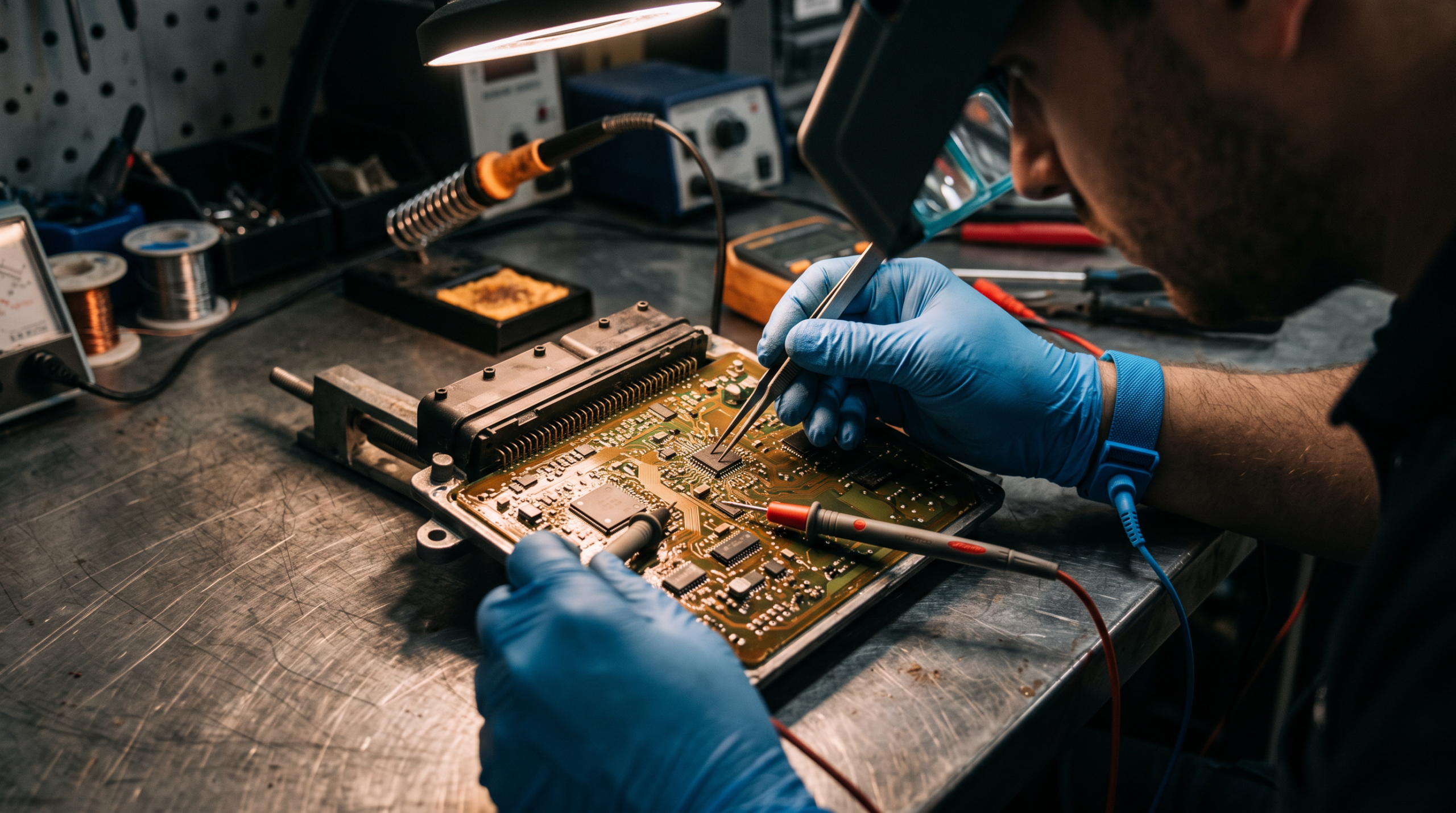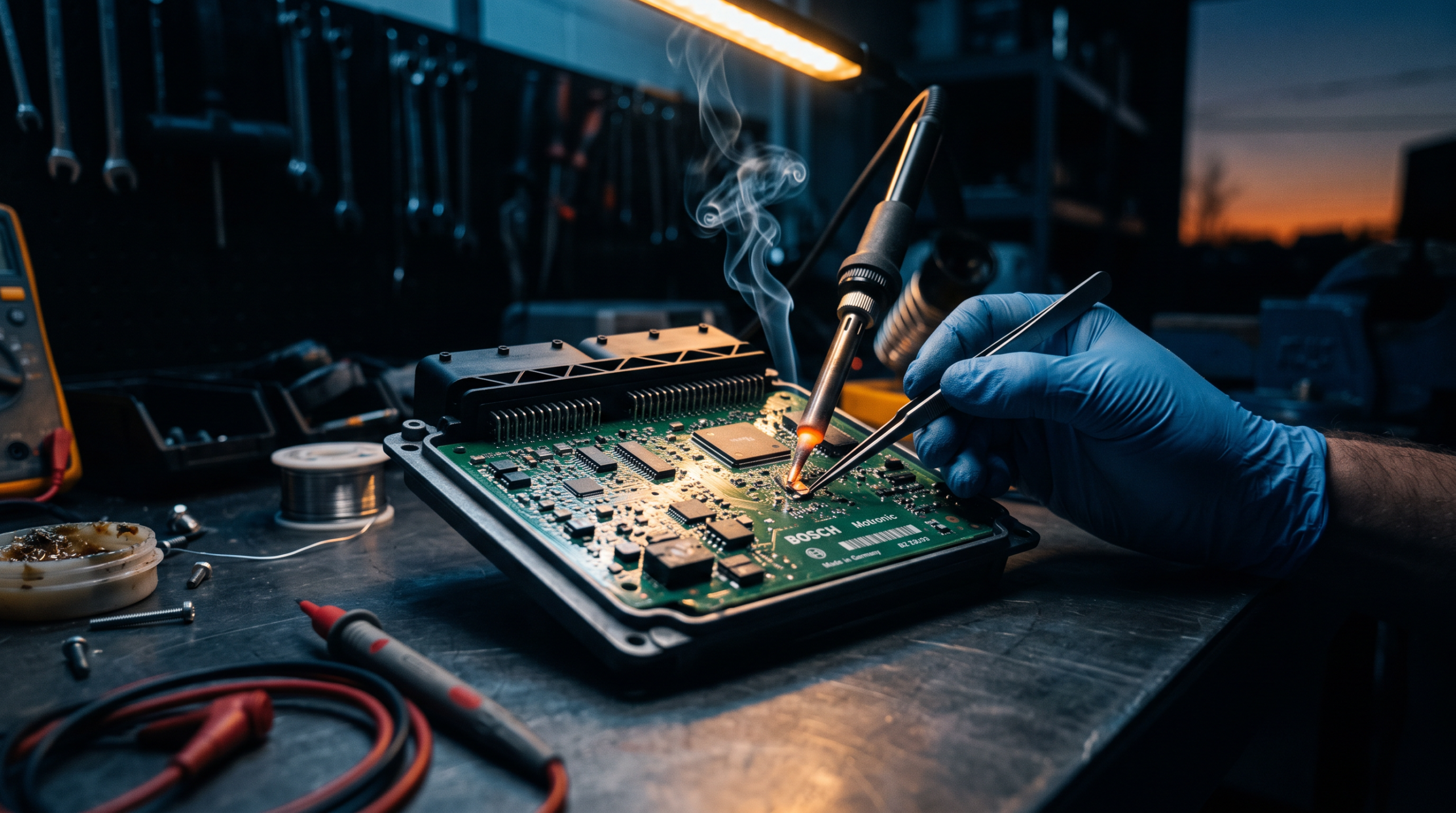
The honest answer to how long does ECU programming take is this: a straightforward software flash on a modern VAG car runs 20 to 90 minutes, but the full job, from plugging in to a car that drives away with every function working, is usually a half-day appointment. A plug-and-play calibration might finish inside an hour. A replacement engine ECU that needs component protection cleared and immobiliser data written can fill a working day. That spread is not padding. It comes down to which module you are touching, the platform it sits on, and whether the unit is new, used, or a clone.
Whether you are a car owner staring at a dead module or a workshop that has run past the limit of its diagnostic kit, the same question sets your schedule. So here is exactly what the clock is doing during ECU programming, where the minutes actually go, and why a specialist closes in one pass what can tie up a general shop for a week.
How long does ECU programming take for a simple flash?
For a like-for-like software update or a calibration change on a module that is already fitted and talking, how long does ECU programming take in practice? Usually 20 to 45 minutes of active data transfer, plus setup and verification on either side of it. The write itself is the slow part, not the clever bit.
A modern engine control unit on the MQB platform holds roughly 4 to 16 MB of flash memory. Pushed over the standard CAN bus (pins 6 and 14 of the OBD-II port) at 500 kbit/s, that file takes real time to move. Newer MQB and MLB Evo cars that support DoIP (diagnostics over IP) shift the same data far faster through the gateway, sometimes turning a 40 minute write into under 15. Older PQ35 and PQ46 cars on plain CAN sit firmly at the slow end.
Then there is the housekeeping around the write. The tool reads the current software state, checks battery voltage, writes the new flash container, runs a checksum to confirm the data landed intact, then re-codes and re-adapts the module so it behaves correctly in the car. All of it counts toward how long does ECU programming take, not just the seconds the progress bar is moving.
The power supply factor
Voltage is the quiet killer. A flash that dips below roughly 12.2 V partway through the write is the most common way a driveway attempt turns a 30 minute task into a recovery job. A proper setup keeps a regulated 13.5 V supply on the car for the entire session, so the module never loses power mid-write. That one piece of kit is a large part of why a specialist quote reads the way it does.
How long does ECU programming take on a used or replacement unit?
Here the timeline changes shape. Fit a used module or a blank new one and how long does ECU programming take stops being just about the flash. Now you are into adaptation, immobiliser synchronisation, and on nearly every VAG car built since about 2010, component protection.
Component protection (Komponentenschutz) locks certain modules to one car’s identity. Fit a used comfort module, instrument cluster, or steering column electronics from a donor vehicle and the car refuses to accept the part until the protection is cleared against VAG’s online servers. That component protection removal step is fast when you hold the right online (GeKo) access. Without it, a used part will not function no matter how many times you reflash it. This is the classic reason a job that “should take an hour” quietly eats a whole day at a shop that cannot clear it.
For a replacement engine ECU the sequence runs like this: read the immobiliser data from the old unit if it is still readable, write it into the new one, adapt the ECU to the gearbox and immobiliser, then clear component protection. Handled correctly on the bench this is a 2 to 4 hour job. Handled by trial and error, it is how good cars end up back on a flatbed.
How long does ECU programming take remotely versus in person?
A large share of VAG coding and programming no longer needs the car on a ramp in front of the technician. With a laptop, a stable internet connection, and a pass-through interface plugged into the OBD-II port under the dash, a specialist runs the same session from another city or another continent. So how long does ECU programming take when it is done remotely? For coding, retrofits, and software updates, about the same as in person once the link is live, commonly 30 to 60 minutes.
Be clear about what each path can do. Remote handles feature coding, hidden-function activation, software updates on units already installed, and clearing many stored faults. Hands-on work is still needed to physically swap a bricked module, to bench-flash a dead ECU that will not wake on the bus, and for any job that needs the case opened for boot-mode or BDM access. A simple test holds up well: if the module powers up and answers on the bus, remote is on the table. If it is dead, it comes to the bench.
What actually drives the time
Ask ten technicians how long does ECU programming take and you will get ten answers, because each one is picturing a different job. These are the factors that genuinely move the number:
- Module type. An engine or transmission controller carries far more data and adaptation than a door module or an infotainment head unit.
- Platform and bus speed. MQB and MLB Evo cars with DoIP flash quickly. Older CAN-only cars are slower by design, and nothing changes that.
- New, used, or clone. A virgin unit needs full coding from scratch. A used one needs component protection cleared. A cloned unit needs the donor data transferred first.
- Security access. Many modules from around 2020 onward use signed software and SFD (protected diagnostics) that demand an online token before they will unlock.
- Data quality. If the old unit is unreadable, the immobiliser and coding data has to be rebuilt from other sources, which adds hours.
Why a specialist finishes faster
Speed on VAG cars comes from access and repetition, not from rushing. Online (GeKo) rights, the correct ODIS flash files, a regulated power supply, and having done the exact module a hundred times before are what compress the timeline safely. A general shop without VAG online access hits the component protection wall and stops, then the car waits days for a subcontractor. Tools matter as well. Ross-Tech’s VCDS is excellent for coding and adaptation, while factory-level flashing of a replacement ECU leans on the OEM access that Audi and the wider VAG network use internally. That access is the difference in how long does ECU programming take between a same-day fix and a car that sits for a week, and it is the whole point of our ECU programming and coding services.
So how long should you budget?
Realistic numbers, so you can plan the day: a simple flash or coding change, 30 to 90 minutes. Retrofit coding for a new feature, 1 to 2 hours. A used module needing component protection, half a day once appointment and verification time are counted. A new or replacement engine ECU with immobiliser work and adaptation, 2 to 4 hours of bench time, which usually means a full appointment slot. Diagnosis before any of it can add another 30 to 60 minutes when the fault is not yet confirmed.
The short version of how long does ECU programming take: budget an appointment, not a coffee break, and expect a clean job to beat a cheap one every single time. If your unit still talks on the bus, our remote VAG programming service can often have it sorted the same day without you leaving your driveway. For everything from a single line of coding to a full replacement across Audi, Volkswagen, Porsche, Bentley, and Lamborghini, the timeline is only ever as long as the job genuinely needs, and never a minute longer.
Is Your VAG Vehicle Showing This Issue?
Whether you are a car owner dealing with a fault, a workshop needing a specialist partner, or an enthusiast looking to unlock your vehicle’s full potential, VAG Programming offers expert remote and in-person ECU coding, programming, and diagnostics for Audi, Volkswagen, Porsche, Bentley, and Lamborghini worldwide.
Contact us today and let’s fix it the right way.