If a Porsche throws a fault and the dealer tells you the DME needs replacing, you are facing two problems at once, not one. The first is the part itself. The second, and the one that catches most people out, is that a new or used control unit will not simply run once it is bolted in. It has to be coded to your exact car, matched to the vehicle identification number, and cleared of component protection before the engine will start and behave the way it should. Solving that second problem is the entire reason a porsche ecu coding specialist exists.
This piece is written for two readers. If you are an owner staring at a dealer quote, you will see what the work actually involves and why it does not have to mean a long trip or a huge bill. If you run a workshop and have hit the limit of your equipment on a locked Porsche module, you will see exactly where a specialist partner picks the job up. Either way, a good porsche ecu coding specialist is what stands between you and a bricked unit sitting in a car that will not leave the ramp.
What a Porsche ECU Coding Specialist Actually Does
Three words get thrown around loosely, so let us keep them straight. Programming, or flashing, writes the firmware onto the control unit. Coding tells that firmware which options and hardware the car actually has. Adaptation teaches the unit live values such as throttle position and fuel trims. A replacement DME usually needs all three, done in that order, before the car drives like it did before.
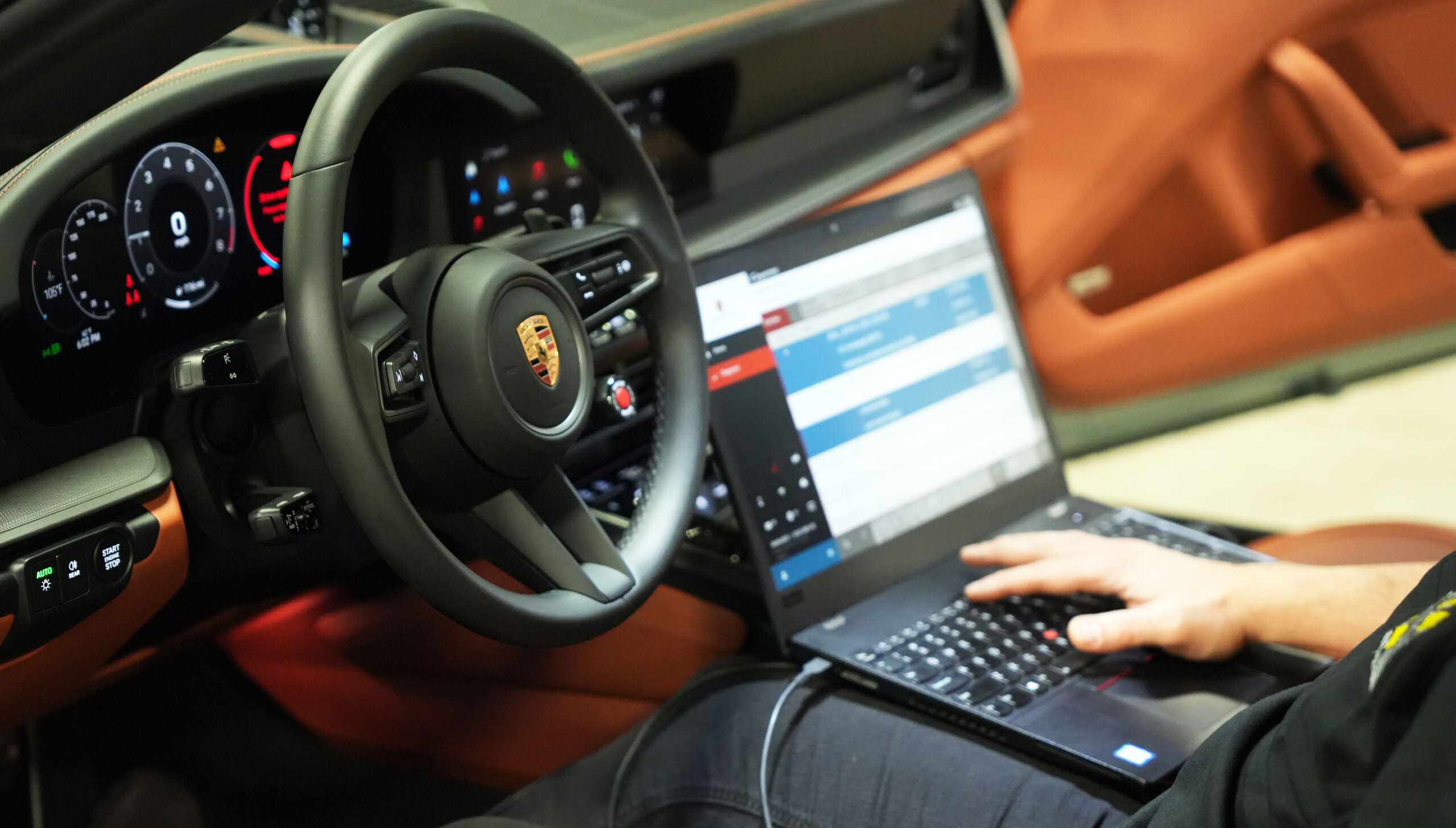
On a modern Porsche the factory tool for this is the PIWIS Tester, currently PIWIS III, running an online session back to Porsche’s own servers. A porsche ecu coding specialist replicates that process with professional equipment of the same class. Our ECU programming and coding services read the configuration from the original unit wherever it can still be read, then write it to the replacement so the car sees the same options it left the factory with. Sport Chrono, PASM, the sports exhaust flap valve, and the PDK gearbox mapping are each a coded option that has to be present and correct in the new module, or the feature simply goes missing.
Why a Replacement Porsche ECU Will Not Just Plug In
Every Volkswagen group control unit ships with component protection, and Porsche is part of that group. The Germans call it Komponentenschutz. It ties a control unit to one specific VIN, so a module stolen from another car or pulled from a scrapyard donor refuses to work until an authorised online session releases it. It is a genuine anti-theft measure, and it is also the single biggest reason a used ECU fails to start the car it was just fitted to.
Component protection sits on far more than the engine unit. Instrument clusters, the PDK transmission controller, steering column locks, and infotainment head units all carry it. When any of those is swapped, the protection has to be removed and the unit re-married to the car. Our component protection removal service handles exactly this, and it is the step most general workshops cannot finish, because it needs authenticated online access that a generic scan tool does not have.
Coding a Used ECU or Cloning the Original DME
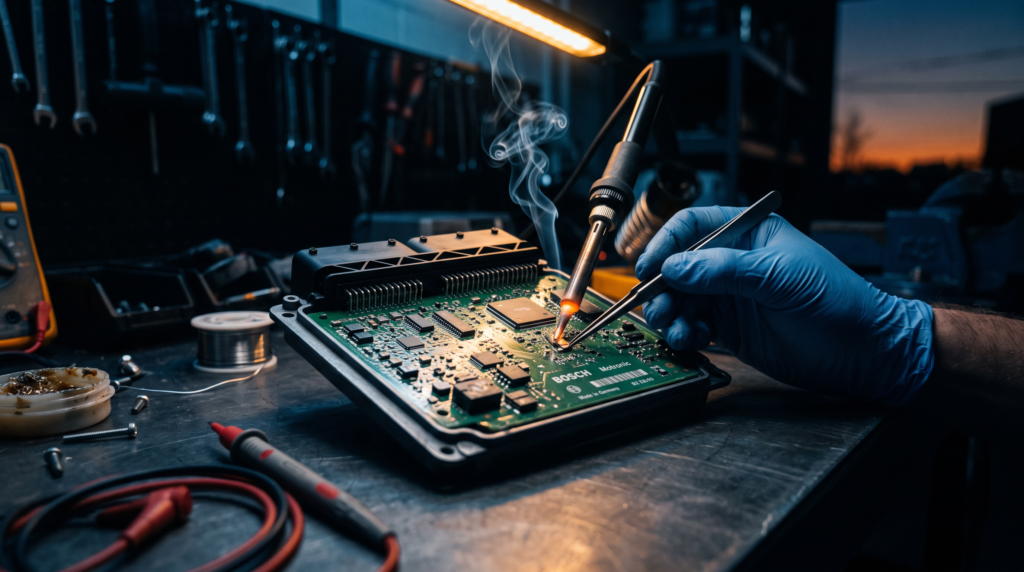
There are two clean routes to a working replacement. The first is coding a used or new bare unit to the car and then clearing component protection. The second is cloning, which copies the full data image, including immobiliser data, mileage, and learned adaptations, from the original DME onto a matching donor unit. Cloning is often the tidier path when the original still reads but has a failed power stage or water ingress, because the car effectively gets its own brain back on healthy hardware. Our ECU cloning and data transfer route is built for that exact case.
Which one a porsche ecu coding specialist recommends comes down to the state of the original unit and the exact hardware part number. Cloning demands a donor with an identical hardware number, no exceptions. Coding a bare unit is more forgiving on donors but leans entirely on a clean component protection release. Getting that judgement right, before anything is written to the car, is most of the job.
Why the Right Porsche ECU Coding Specialist Matters
Get any of this wrong and the failure modes are ugly. A mismatched software version can drop the car into limp mode with a permanent low rev ceiling. An interrupted flash over a weak battery can brick the DME outright, turning a repairable unit into scrap. Skip the immobiliser adaptation and the engine will crank all day but never fire. On a Taycan or a hybrid Panamera, careless work near the high-voltage system is a safety issue, not just a warranty one.
This is why the equipment and the connection matter as much as the knowledge does. A stable bench supply holding around 13.5 volts through the whole flash, a verified data image, and the correct routing on the OBD-II port (pin 16 for power, pins 6 and 14 for the CAN-C bus a Porsche talks on) separate a clean job from an expensive mistake. Modern cars are rolling networks of control units, as Car and Driver has documented for years, and a Porsche sits at the dense end of that scale. A seasoned porsche ecu coding specialist treats all of it as routine rather than a gamble.
Remote Porsche ECU Coding With No Trip Required
Here is the part owners rarely expect. Most of this can be done without you going anywhere at all. For a great deal of coding and component protection work, a porsche ecu coding specialist runs a secure session through an interface plugged into your OBD-II port, with a laptop and a stable internet connection at your end. You stay on your own driveway while the work happens through our remote VAG programming service.
Being honest about the limits matters just as much. Cloning a physically failed unit, or bench-flashing a DME that will no longer wake up on the car, needs the module in hand, so that part is either done in person or by post. Diagnosing an intermittent fault before you spend on a new unit is always worth doing first, because plenty of so-called dead ECU cars turn out to have a wiring or connector fault instead. A specialist tells you which camp your car is in before you buy a part you may not need.
How to Choose a Porsche ECU Coding Specialist
Ask three concrete things before you hand over a Porsche. Can they match the exact hardware part number stamped on your DME? Can they clear component protection through a proper authenticated session, rather than a workaround that leaves faults stored in the background? And can they show that the coding will restore your car’s specific options, from a 992 generation 911 back through the 9Y0 and 958 Cayenne? A specialist who answers those cleanly is worth far more than the cheapest quote on a forum.
Platform knowledge is a big part of it too. A Panamera on the MSB platform, a Cayenne on MLB Evo, a Macan on MLB, and a Taycan on the J1 architecture each behave differently around coding, gateway access, and how the modules talk to one another. A real porsche ecu coding specialist already knows those differences before the interface is even plugged in, which is what keeps a routine job routine.
The Bottom Line
A replacement ECU on a Porsche is not a plug and play part, and treating it like one is how good units get bricked and good cars get stranded on a driveway. The coding, the component protection release, and the adaptation are specialist work with specialist consequences when they go wrong. Whether you are an owner avoiding a heavy dealer bill or a workshop that needs a partner for the locked module sitting on your ramp, a porsche ecu coding specialist is who turns a boxed control unit back into a running car. Match the part, respect the process, and have it done by someone who does it every week.
Is Your VAG Vehicle Showing This Issue?
Whether you are a car owner dealing with a fault, a workshop needing a specialist partner, or an enthusiast looking to unlock your vehicle’s full potential, VAG Programming offers expert remote and in-person ECU coding, programming, and diagnostics for Audi, Volkswagen, Porsche, Bentley, and Lamborghini worldwide.
Contact us today and let’s fix it the right way.