Your Audi left the factory with features switched off. The hardware is there, the software knows about it, and a few coding changes in the right control modules turn it on. That is what Audi hidden features unlock coding means in practice: a technician connects to the OBD port, changes long coding bytes and adaptation channels in modules like the instrument cluster, central electronics and MMI, and the car starts doing things the order sheet never asked for. Needle sweep on start-up, a different ambient light palette, video playback while rolling, traffic sign display, comfort flashers with five blinks instead of three. None of it needs new parts.
The important distinction is between coding and retrofit. Coding is software only. Retrofit means adding physical hardware first, then coding the car to accept it. Apple CarPlay on a 2017 A4 is usually a coding job. Adaptive cruise on a car that never had the radar is a retrofit. This article covers both, lists the features we get asked about most, explains which ones can be done remotely, and sets out where Audi hidden features unlock coding stops being a quick session and becomes a proper installation. We work on these cars every week through our ECU programming and coding services, so the examples below come from real jobs, not forum rumours.
What Audi hidden features unlock coding actually changes
Every control module in a modern Audi carries two kinds of configuration. Long coding is a string of bytes that tells the module which equipment is installed and which behaviours are allowed. Adaptation channels are individual settings with names and values, such as the number of comfort turn signal flashes or whether the needles sweep on ignition. Audi hidden features unlock coding is the act of editing those two layers with a diagnostic tool. The module firmware is untouched. Nothing is flashed. The car simply reads a new configuration and behaves accordingly.
The modules that matter most are easy to name. Module 09 is central electronics and handles lighting, windows, locking and most convenience features. Module 17 is the instrument cluster, including the Virtual Cockpit. Module 5F is the MMI head unit, which owns video in motion, the smartphone interface and the display menus. Module A5 is the front camera behind the windscreen, responsible for lane assist and traffic sign recognition. Module 19 is the gateway, which keeps the installation list of every module the car should expect on the bus. Change equipment and forget the gateway, and the car logs faults every time it wakes up.
Platform matters because the same feature lives in different places on different cars. MQB cars such as the A3 8V and 8Y, Q2, Q3 F3 and TT 8S share logic with the Golf 7 and 8. MLB evo cars such as the A4 B9, A5 F5, Q5 FY, A6 C8, A7 4K, Q7 4M and Q8 use a different gateway, a different cluster and, from 2015, the MIB2 High infotainment that handles feature licences in its own way. Older MLB cars with MMI 3G or 3G plus, like the A4 B8 and the pre-facelift A6 C7, can still be coded but have fewer software-only options. Knowing the platform is the first thing we check before quoting a job.
Audi hidden features you can unlock with coding alone
These are the requests that fill most of our booking calendar. Each one is software only, provided the car already has the hardware, which we confirm from the part numbers and the gateway installation list before we start.
- Needle sweep (staging). On ignition, the speedometer and tachometer needles swing to full scale and back. On most 2013 and newer cars this is one adaptation in module 17 and takes under a minute. On the Virtual Cockpit it also animates the digital gauges.
- Video in motion. The MMI normally blocks DVD, SD card or USB video above walking pace. Coding in module 5F removes the lock. We tell every customer the same thing: this is for passengers and for parked viewing, and the driver remains responsible for local law.
- Traffic sign recognition. If the car has the front camera for lane assist but the sign display was not ordered, coding in module A5, the cluster and the MMI turns on the display. On MIB2 High cars the MMI side may need a feature enablement code, which we cover below.
- Ambient lighting changes. Cars fitted with the multi-colour ambient package can have the colour profiles, the brightness mapping and the contour versus surface split adjusted in module 09 and the door modules. Cars with the single-colour package can often switch to a different fixed colour.
- Comfort turn signals. Three flashes from the factory, selectable between one and five in module 09.
- Coming home and leaving home lighting. Headlights stay on for a set number of seconds after locking or unlocking, with the time value adjustable, on cars with auto lights.
- Emergency brake flashing. Hazard lights pulse under hard braking, then stay on once the car stops. A safety feature we recommend on any car that supports it.
- Windows and sunroof from the key. Hold the unlock button and all windows open. Hold lock and they close. Rain closing can be added on cars with a rain sensor.
- Mirror dip in reverse. The passenger mirror tilts down to show the kerb when reverse is selected and the mirror selector sits on the passenger side.
- Lock confirmation beep, auto lock and auto unlock. The car chirps when locked, locks itself above 15 km/h and unlocks when the key is removed.
- Virtual Cockpit layouts. The sport layout with the central tachometer and the lap timer can be enabled on many Virtual Cockpit cars that were not ordered with the sport package.
- Start-stop behaviour. Several cars can remember the last start-stop state or default to off, depending on the generation and the battery energy management version.
- Seat belt chime, DRL menu, cornering lights via fog lamps and gauge display options. Small quality of life tweaks that a session of Audi hidden features unlock coding can bundle together in one visit.
A single remote session usually covers ten to fifteen of these. The practical limit is not the coding time but the verification. We test each feature with the customer at the car before closing the session, because a feature that looks enabled in the software but does nothing on the road is worthless.
Hidden features that need a retrofit before coding
This is where Audi hidden features unlock coding stops and physical work begins. If the hardware is absent, no amount of coding will create it. What coding does is make the car accept the new part, add it to the gateway installation list and teach the other modules to talk to it.
- Apple CarPlay and Android Auto. On 2016 and newer cars with MIB2 High (MMI Navigation plus) or a compatible MIB2 Standard unit, the smartphone interface is a software licence plus a data-capable USB hub, so it sits close to the coding side. On earlier MIB1 cars and the MMI 3G family the head unit does not support it, so the choice is a replacement unit or an aftermarket interface box wired behind the screen.
- Rear view camera. Camera in the boot handle or tailgate trim, wiring to the MMI or to the dedicated camera module, then coding in 5F, 19 and the camera module. A used camera from another car will usually carry component protection, which has to be cleared with online access before it will show an image.
- Adaptive cruise control. Radar sensor in the bumper, a bumper cut-out or trim, wiring to the CAN bus, a new stalk or steering wheel buttons on some cars, then coding in modules 13, 17, 09, 19 and 5F, and often the ABS and engine modules too. The radar then has to be aligned with proper calibration equipment. This is a workshop job, never remote.
- Lane assist and traffic sign recognition on cars without the camera. Camera in the mirror base, a new mirror bracket or windscreen on some models, coding in A5, 44 steering assist, 16 steering column electronics and the cluster, then a static camera calibration with a target board. Again, workshop only.
- Ambient lighting retrofit. LED strips or lit door inserts, wiring to the door modules and the central electronics, then coding to match the package code. More labour than people expect on cars without the pre-wiring.
- Head-up display, Audi side assist, Virtual Cockpit swap, keyless entry, power tailgate. All real and all regularly done, but each needs the parts, often a replacement harness section, and in several cases online parameterisation of the new module with the VIN.
For every retrofit we quote in two halves: the hardware and fitting, then the coding and any component protection or licence work. If you are sourcing used parts yourself, send us the part numbers and the donor VIN first. Our retrofits and custom option coding page lists what we fit in-house and what we support for independent workshops doing the physical install.
Tools, licences and the limits of a cable
Most software-only features can be done with Ross-Tech VCDS, which exposes long coding and adaptation channels on every module, or with OBDeleven, which wraps the common ones in one-click apps. Both are fine for the basics. The complications start with the MIB2 High and MIB3 head units. Audi introduced feature enablement codes, signed activation files tied to the individual head unit, for things like the smartphone interface and some navigation and display options. A plain coding tool cannot generate those. They need either a dealer-level online session or a specialist with the right tooling, and the process differs on an MMI that has been software updated versus one still on its delivery version.
Newer cars raise the bar again. From 2020 Audi started selling some options after delivery through its own Functions on Demand programme, with activations tied to the backend and the owner’s myAudi account. You can read how Audi presents that officially. Independent coding does not reach into that system, so if the feature you want is a Functions on Demand item on a 2021 or newer car, the honest answer is that the dealer route is the supported one, and we will tell you so before taking any money.
Two technical rules apply to every session, remote or in person. First, keep a charger on the battery holding at least 13 volts. A module that loses power halfway through a coding write can end up in a state that needs a flash to recover. Second, back up the original coding of every module before changing anything. We save a full scan and the long coding strings so any change can be reverted in minutes, and we hand that backup to the customer.
Remote Audi hidden features unlock coding
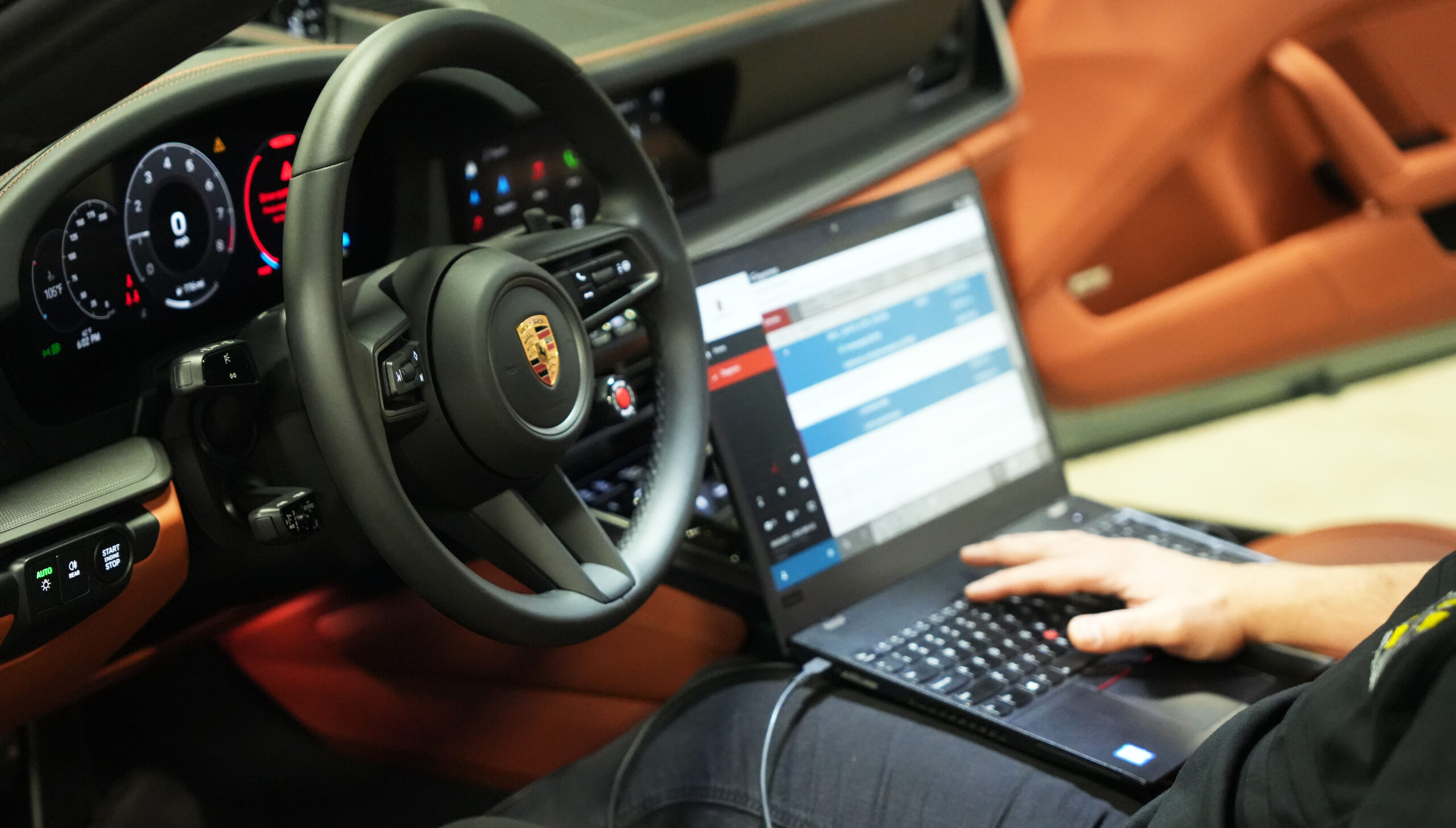
Most Audi hidden features unlock coding work is done remotely. The customer needs a Windows laptop, a supported OBD interface, a stable internet connection and the battery charger. We connect through a remote desktop session, the interface sits in the OBD port under the dash, and we work on the car as if we were in the seat next to you. The whole session for a typical ten-feature list takes about an hour including testing.
Remote works for every item in the coding-only list above, for feature enablement work where the head unit supports it, for component protection clearance on a part the customer has already fitted, and for the post-install coding on retrofits done by a local workshop. It does not work for anything that needs a spanner, a calibration target or a radar alignment. We are upfront about that split because a customer who expects a remote session to fit a rear camera has been told the wrong thing somewhere.
Workshops use the same model. A mechanic fits the parts in their own bay, then we take over the coding, the gateway list and the licence work through the interface they keep in stock. That turns a job the shop would otherwise send to the dealer into one they can finish the same day.
Before you book
A short checklist saves everyone time and avoids disappointment with Audi hidden features unlock coding.
- Know your model, year and platform. A 2015 A3 8V and a 2019 A3 8V with MIB2 High are two different jobs.
- Confirm the hardware. The option codes on the sticker in the boot or the service book, or a photo of that sticker, tell us most of what we need.
- Note the MMI software version from the version menu. Feature licences depend on it.
- Decide what you actually want. Ten features in one session is normal and priced as one session, so there is no benefit in staging them over several visits.
- Understand that coding is logged. Changes are visible to a dealer. They are reversible, and we keep the backup, but a software update at a service visit can reset some of them.
- Expect us to refuse anything unsafe. Disabling airbag warnings or defeating emissions related functions is not coding we do.
The short version
Audi hidden features unlock coding is one of the best value changes you can make to a car you already own. Needle sweep, ambient colours, comfort flashers, video in motion, traffic sign display and Virtual Cockpit layouts are all sitting in the software waiting for a few bytes to change. Features that need hardware are still possible, they just need an honest plan that covers parts, fitting, calibration and the online licence work. Send us the model, year and the list of features you want and we will tell you what is coding, what is retrofit, and what we can do today through our remote VAG programming service.
Is Your VAG Vehicle Showing This Issue?
Whether you are a car owner dealing with a fault, a workshop needing a specialist partner, or an enthusiast looking to unlock your vehicle’s full potential, VAG Programming offers expert remote and in-person ECU coding, programming, and diagnostics for Audi, Volkswagen, Porsche, Bentley, and Lamborghini worldwide.
Contact us today and let’s fix it the right way.