A vw check engine light diagnosis done right starts with one fact: that amber glow on your dash is a symptom, not a diagnosis. The light means the engine control unit logged a fault and decided it was worth telling you about. It does not tell you what failed, why, or what it costs. A generic code reader will hand you a five character number and a vague description. A proper diagnosis reads the full story across every control module in the car, looks at the live data behind the fault, and confirms the cause before anyone touches a wrench.
This is where most generic scans fall short, and where a real VAG diagnostic earns its keep. Below is what actually happens during a thorough vw check engine light diagnosis, what tools separate a guess from a verdict, and how much of it can now be done remotely without the car ever leaving your driveway.
What the Check Engine Light Actually Tells You
The check engine light, properly called the malfunction indicator lamp (MIL), is controlled by the engine ECU. On a modern Volkswagen it illuminates when a monitored value drifts outside its expected range for long enough to set a confirmed fault. A steady light usually means an emissions related fault. A flashing light means active misfire serious enough to damage the catalytic converter, and you should stop driving.
Common triggers include lean or rich fuel trims, misfire counts on one or more cylinders, an EVAP system leak, a boost pressure deviation on turbo engines, or a lazy oxygen or NOx sensor. Each of those sets a different fault code, and each points down a different path. That is the first reason a real vw check engine light diagnosis beats a parts cannon approach. Reading the code is step one of about six.
Generic OBD Scan vs a Proper VW Check Engine Light Diagnosis
Every car sold since 2008 in North America supports generic OBD-II. Plug in a cheap reader, request mode $03, and it returns standardized powertrain trouble codes from the engine module. That is genuinely useful for a rough idea. It is also where the cheap tool stops.
A VW is not one computer. A current MQB platform Golf or Tiguan carries 30 to 60 networked control modules: engine, transmission, ABS, airbag, the comfort system, the gateway, the instrument cluster, and more. Generic OBD only sees standardized engine codes. It cannot read the manufacturer specific faults stored in those other modules, and it cannot read the extra detail VW stores alongside an engine fault. A genuine vw check engine light diagnosis uses factory level tooling to scan all of them.
VCDS and ODIS Level Scanning
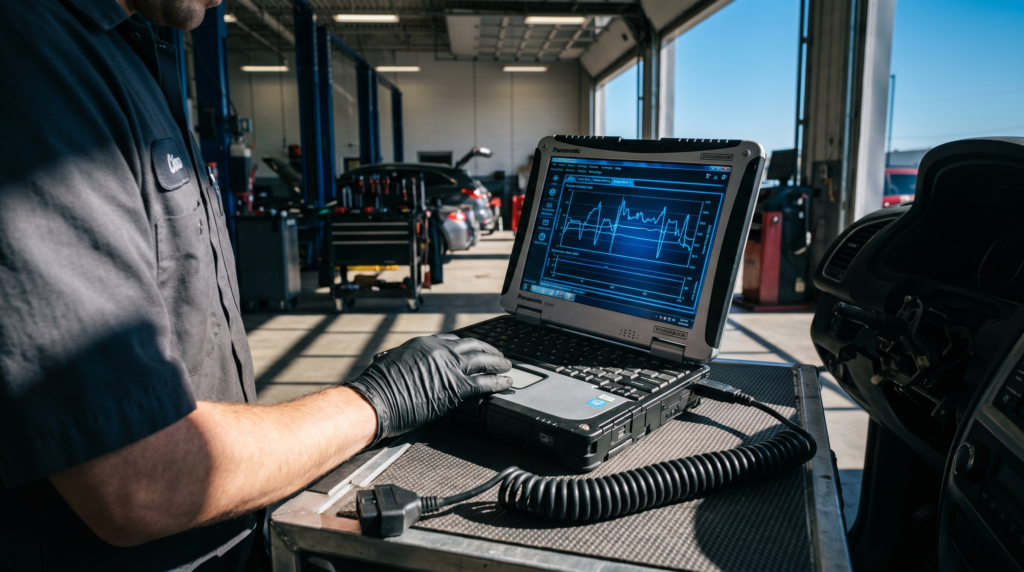
The two tools that matter here are Ross-Tech VCDS and the factory ODIS system. Both run a full auto-scan that walks every module on the car and lists every stored fault, manufacturer specific codes included, with the status byte that tells you whether the fault is active right now or stored from the past. VCDS will also pull freeze frame data: engine RPM, coolant temperature, calculated load, and short and long term fuel trims captured at the exact moment the fault set. That snapshot is often what turns a vague code into an obvious cause.
Live Data and Measuring Blocks
Codes tell you what already failed. Live data tells you what is failing now. Watching measuring blocks in real time, a technician can compare commanded versus actual boost on a turbo, watch both fuel trim banks react to a controlled vacuum leak, or confirm whether an oxygen sensor is actually switching. A P0171 system too lean code does not mean replace the sensor. Live fuel trim data tells you whether you are chasing an intake leak, a weak fuel pump, or a dirty mass airflow sensor. This live view is the heart of any serious vw check engine light diagnosis.
Guided Fault Finding and Adaptation Channels
ODIS adds guided fault finding, a factory test plan that walks through the checks Volkswagen engineers wrote for that specific fault on that specific engine. Combined with output tests, which let you command a component on and off to confirm it works, and adaptation channels, which store learned values and coding, this is diagnostic depth no generic scanner can reach. Our full vehicle diagnostics and troubleshooting work runs at this level as standard.
What a Full Diagnostic Report Should Include
- A complete auto-scan listing every control module and every stored fault, not just engine codes.
- Freeze frame data for each fault, so the conditions at the moment of failure are on record.
- Live measuring blocks for the suspect system, recorded during a road test where needed.
- A confirmed cause, separating the failed part from the code it triggered.
- A clear next step, whether that is a coding correction, a software update, or a physical repair.
Why the Code Is the Start, Not the Answer
Here is the trap that empties wallets. A scanner shows P0299 underboost, and someone orders a turbocharger. The actual cause was a split charge pipe clamp that costs almost nothing. The code described the symptom the ECU saw. It did not name the failed part. A correct vw check engine light diagnosis treats the code as a direction, then uses live data, freeze frame, and physical inspection to confirm the fault before any part is ordered.
This matters more on VW and Audi than on most brands, because the platforms are tightly integrated. A fault flagged by the engine ECU can originate in the gateway, a CAN bus communication dropout, or a module that lost coding after a battery change. Replacing parts against a raw code list is how a cheap repair turns expensive.
When Programming and Coding Enter the Picture
Sometimes the fault is not a broken part at all. It is software. A module that was swapped, a control unit that lost its adaptation, or a component that needs coding to the car will all set faults that look mechanical until you read them properly. That overlap is why diagnostics and programming belong under one roof. Once the cause is confirmed, the same connection used to read the fault can often correct it through ECU programming and coding services, from clearing and re-adapting a module to flashing corrected software.
How Much of a VW Check Engine Light Diagnosis Can Be Done Remotely
More than people expect. The OBD-II port on every modern VW is a standard 16 pin connector. Pin 16 supplies battery voltage, pins 4 and 5 are ground, and pins 6 and 14 carry the CAN bus high and low signals the diagnostic tool talks over. Plug a supported pass-through interface into that port, get it online, and a specialist can do the work from anywhere in the world.
Remotely, we can run a full auto-scan, read manufacturer specific fault codes and freeze frame data, watch live measuring blocks, run many output tests, adjust adaptation channels, and handle a large share of coding and retrofit work. That covers a real portion of a vw check engine light diagnosis and most coding jobs.
Being honest about the limits matters too. A remote session cannot turn a wrench. If the fault is a physically failed sensor or a torn boot, someone on site still has to replace it, though we can guide a local hand through it and verify the repair afterward. Some security gated functions, like certain immobilizer and component protection operations, need specific online access. Everything that is data, software, and coding, though, travels down the wire. Our remote VAG programming service is built exactly for this.
Getting It Right the First Time
A proper vw check engine light diagnosis saves money because it confirms the cause before anyone spends a dollar on parts. The light is a starting flag, not a sentence. Read across every module, study the live data, follow the guided test plan, then act. Whether you are an owner who wants a straight answer or a workshop that needs depth beyond your current scanner, that is the difference between guessing and knowing.
If a warning light is on right now, do not let a parts swap lottery decide your repair. A focused vw check engine light diagnosis, in person or remote, will tell you what is actually wrong and what it takes to fix it. For background on the systems behind that dashboard light, Volkswagen documents its engine and driver assistance technology at volkswagen.com.
Is Your VAG Vehicle Showing This Issue?
Whether you are a car owner dealing with a fault, a workshop needing a specialist partner, or an enthusiast looking to unlock your vehicle’s full potential, VAG Programming offers expert remote and in-person ECU coding, programming, and diagnostics for Audi, Volkswagen, Porsche, Bentley, and Lamborghini worldwide. Contact us today and let’s fix it the right way.