A warning light on the dash, a flat spot under throttle, or a gearbox that suddenly shifts hard usually points to the same thing: a control module on your Volkswagen has detected a fault and stored a code in its memory. Reading that code correctly is the difference between a real fix and an expensive guess. Proper volkswagen fault code reading is not plugging a cheap dongle into the port and reading one generic number. It means scanning every module, in VW’s own diagnostic language, with live data and adaptation access behind it.
That distinction matters because a modern VW is not a single computer. A Golf on the MQB platform can run 30 to 60 separate control units, each with its own fault memory and its own way of reporting trouble. A generic OBD scan sees one corner of that picture. Done properly, volkswagen fault code reading interrogates the whole vehicle, points to the module that is actually at fault, and gives you the data to confirm the cause before a single part is ordered.
What Volkswagen Fault Code Reading Actually Means
OBD2 has been mandatory on petrol cars since 1996, with diesels following a few years later. It standardised the 16-pin J1962 connector under the dash, with the CAN bus on pins 6 and 14, battery power on pin 16, and ground on pins 4 and 5. That standard is built for emissions testing. It is weak for diagnosing a complex VW. A basic reader pulls generic powertrain P-codes from the engine controller and little else.
Real volkswagen fault code reading goes module by module. The engine ECU is address 01, the automatic transmission is 02, ABS is 03, airbags are 15, the instrument cluster is 17, the gateway is 19, and the comfort and convenience electronics sit at 09 and 46. A proper scan walks every installed address, reads the stored faults, and reports them in VW’s own format. That includes the older five digit codes such as 00955 or 01314, the newer UDS codes, the freeze frame data captured the moment the fault set, and the status byte that tells you whether a fault is active right now or only stored in history.
Generic OBD Scan vs a Full VAG Module Scan
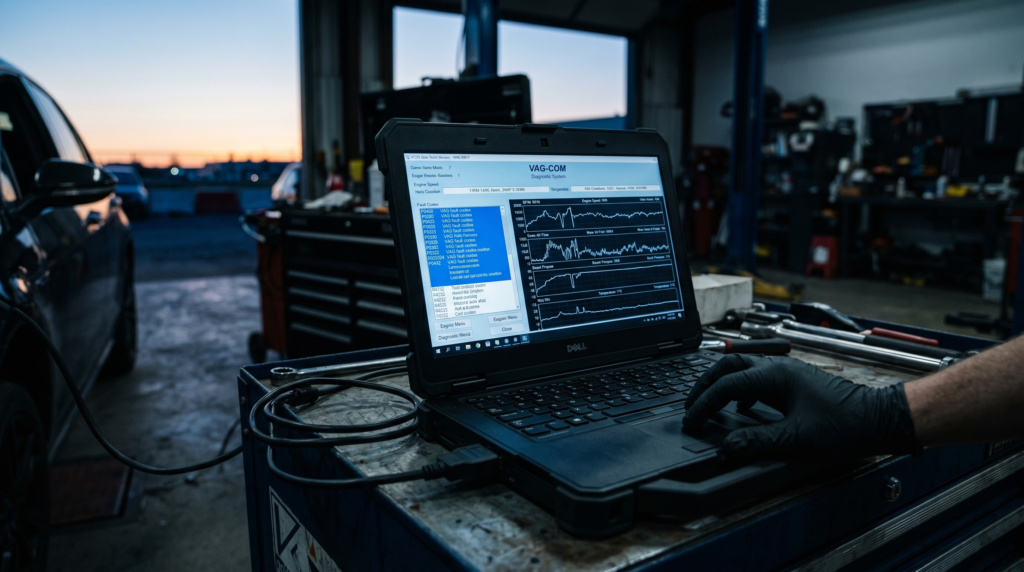
Here is the difference on the bench. A parts shop code reader might tell you P0299, turbo underboost. Useful, but thin. A full VCDS or ODIS scan tells you that same fault sits in module 01, shows the freeze frame with engine speed, load, and boost pressure at the instant it triggered, flags a related low voltage entry in the gateway, and lets you watch actual boost against requested boost in real time. One reader hands you a headline. The other hands you the whole story, which is what you need to fix it once.
The Tools: VCDS and ODIS Level Scanning
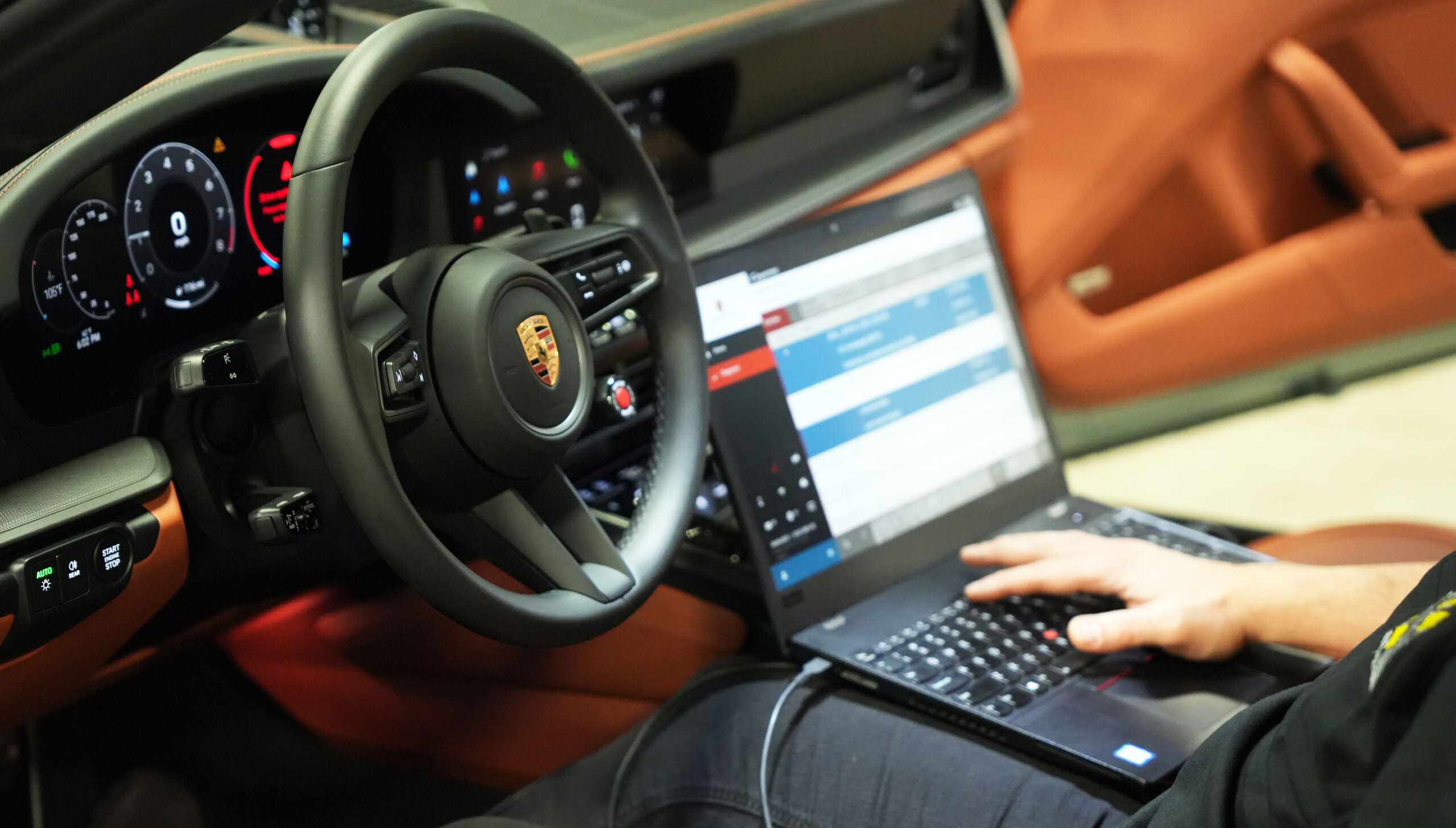
Two tools define serious VAG work. VCDS, made by Ross-Tech, is the aftermarket standard. It reads every module, runs output tests, and exposes adaptation channels. ODIS is Volkswagen’s own dealer system, used for guided fault finding and factory flashing. Both speak UDS and KWP2000, the manufacturer protocols a generic OBD app simply cannot reach. If your shop only owns a generic scanner, this protocol gap is exactly what separates a dealer level result from a guess.
This is also where vehicle diagnostics and troubleshooting stops being about codes and starts being about evidence. A code is a symptom. The job is to prove what set it.
Where Volkswagen Fault Code Reading Gets Real: Live Data
Codes tell you a module saw something wrong at some point. Live data tells you what the car is doing right now. In VCDS these are measuring value blocks, in ODIS they are UDS measuring values, and they are where most real diagnosis happens. You can watch short and long term fuel trims drift, compare commanded against actual camshaft timing, read individual cylinder misfire counters, check readiness monitors, or log lambda voltages on a road test. A stored code might say lean bank 1. Live data shows whether that is a vacuum leak, a failing MAF, or a tired high pressure fuel pump. That is the part of volkswagen fault code reading that no cheap reader can touch.
Adaptation Channels and Guided Fault Finding
Reading is only half the toolkit. VAG modules carry adaptation channels and basic settings that control how a component behaves. Throttle body alignment, steering angle sensor calibration, DSG clutch adaptation, service interval resets, and start-stop behaviour all live here. Some require security access, a login code, before the module will accept a change. ODIS adds guided fault finding, the factory decision tree that walks a technician from symptom to tested cause. Paired with proper ECU programming and coding services, most faults can be diagnosed and corrected without throwing parts at the car.
Faults a Proper Scan Catches That a Cheap Reader Misses
Some of the most common VW complaints never appear on a generic scan. A few from the bench:
- Airbag and restraint faults stored in module 15, which a powertrain only reader never sees. That is a failed safety inspection waiting to happen.
- Comfort module faults in the convenience controller at address 46, often from water ingress through blocked sunroof or plenum drains, showing up as random window, lock, or mirror behaviour.
- Gateway and CAN communication codes in module 19 that explain why three other modules suddenly went silent.
- Component protection entries after a used module swap, where the part is healthy but locked to another car and has to be released.
- Intermittent faults that only sit in history memory with a freeze frame, gone the instant you clear them without reading the data first.
This is why clearing codes before reading the freeze frame is a beginner mistake. The data that set with the fault is often the only clue you get, and once it is gone you wait for the fault to return.
Remote Volkswagen Fault Code Reading
Here is the part many owners do not know. A large share of VAG diagnostic work can be done remotely. With an internet connected pass-thru interface plugged into the OBD port, a specialist can run a full scan, read live data, perform coding and adaptations, and in many cases flash a module, all without the car leaving your driveway. Remote volkswagen fault code reading is a genuine service, not a watered down version of the in person job.
What still needs hands on the car is worth stating plainly. Physical repairs, soldering on a module, cutting or programming a mechanical key, and certain security gated flashing that needs factory online access or GeKo credentials stay in person. Everything in software territory, reading, coding, adaptation, and most programming, travels fine over a remote VAG programming service. For a workshop that means a specialist partner on call. For an owner it means dealer level capability without the dealer trip. It works across the full Volkswagen lineup, from MQB hatchbacks to MEB electric cars.
Getting Your Volkswagen Fault Code Reading Done Right
A warning light is data, not a verdict. The right response is a full scan of every module, freeze frame and live data captured before anything is cleared, and a read of the fault in VW’s own language rather than a generic headline. That is what proper volkswagen fault code reading delivers, whether you are an owner trying to avoid a needless repair or a workshop that needs more capability than the scanner on the shelf. Read the whole car, trust the data, then fix the actual cause. Done in that order, a thorough scan turns a mystery light into a known job with a known price.
Is Your VAG Vehicle Showing This Issue?
Whether you are a car owner dealing with a fault, a workshop needing a specialist partner, or an enthusiast looking to unlock your vehicle’s full potential, VAG Programming offers expert remote and in-person ECU coding, programming, and diagnostics for Audi, Volkswagen, Porsche, Bentley, and Lamborghini worldwide. Contact us today and let’s fix it the right way.