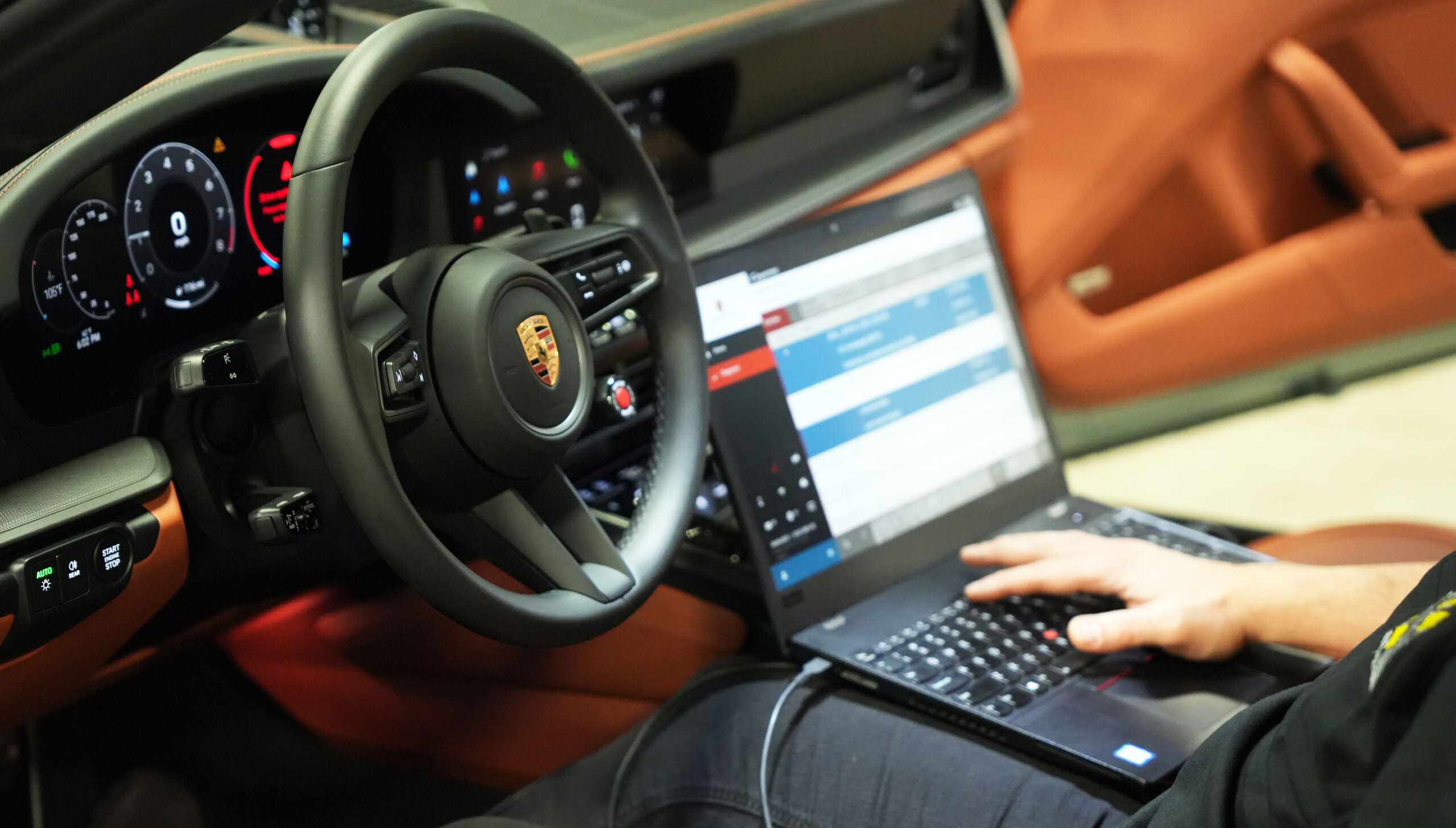

If your Lamborghini Huracan has lit up the dash and stored an engine control unit fault, here is the straight answer: a proper Lamborghini Huracan ECU fault code fix is never just clearing the code and hoping. The 5.2 litre V10 logs that fault for a reason, and on a car this specialised a wrong guess gets expensive fast. This article explains what the code means, what triggers it on the Huracan platform, the symptoms you feel from the driver seat, and what the actual repair involves.
The Huracan is rare, and independent shops that can genuinely work its electronics are rarer still. VAG Programming is one of a small handful of independent specialists worldwide who code, program, and diagnose these cars, so most of what follows applies whether you are the owner or a workshop tech seeing one on the lift for the first time.
What an ECU Fault Code Means on a Lamborghini Huracan
The engine control unit is the brain of the V10. On the Huracan it is a Bosch MED17.1.1 unit, from the same family used across the Audi R8 Type 4S that shares this platform. It reads dozens of sensors thousands of times per second: crank and cam position, both bank lambda sensors, fuel rail pressure, knock, and throttle angle. When a signal falls outside the range the ECU expects, it stores a diagnostic trouble code (DTC) and often drops the engine into a reduced power mode to protect it.
These cars log both standard OBD-II P-codes (like P0087 for low fuel rail pressure) and the five-digit VAG-format codes the group uses internally. A cheap generic reader shows you a P-code and nothing else. To see the freeze-frame data, the measuring blocks, and the manufacturer-specific codes, you need a proper tool: factory-level ODIS, a Lamborghini-capable scan tool, or a well-supported aftermarket kit. The documentation behind tools like Ross-Tech VCDS is a good primer on how VAG stores and labels these faults, though the Huracan needs brand-specific software to go deep.
Symptoms You Actually Notice
An ECU fault rarely stays quiet. Depending on the code, the driver usually feels at least one of these:
- Limp mode: power capped, revs held to around 3,000 to 4,000 rpm, the car refusing to pull.
- Rough idle or misfire: a shudder at idle, a stumble under load, sometimes a clear dead-cylinder feel.
- Warning lights: check engine (MIL), EPC, or the amber powertrain warning on the digital cluster.
- Hard start or no start: often tied to a crank sensor, fuel pressure, or an immobiliser and component protection issue.
- Failed readiness: emissions monitors that will not complete because a code keeps resetting.
None of that tells you the root cause on its own. That is the whole point of running the diagnosis before touching parts.
Common Causes Behind a Lamborghini Huracan ECU Fault Code Fix
Most of the time a Lamborghini Huracan ECU fault code fix traces back to one of a handful of causes. In rough order of how often we see them:
- Sensor faults: a failing cam or crank position sensor, a lazy lambda sensor, or a fuel pressure sensor drifting out of spec. The ECU is healthy and reporting a real problem.
- Wiring and connector issues: corroded pins, a chafed loom, or water intrusion throwing implausible-signal codes that come and go.
- Coil and injector faults: misfire codes (P0301 through P0310) that point at a specific cylinder on the V10.
- Software or coding faults: a module that lost its coding after a battery event, a failed update, or a mismatch after a part was swapped.
- Component protection active: fit a used or replacement ECU and the car refuses it until it is adapted to the vehicle.
That last point is where a lot of DIY and general-shop attempts fall apart, so it earns its own explanation. A correct Lamborghini Huracan ECU fault code fix has to identify which bucket you are in before any part is ordered.
Why Component Protection Complicates Everything
VAG locks its control modules to the individual car through a system called component protection (Komponentenschutz). The ECU, instrument cluster, and several other modules carry a protection value tied to the vehicle identity. Swap in a module from another car and it stores a component-protection-active fault and stays in a degraded state. Clearing the code does nothing. The module has to be adapted to the VIN through the manufacturer online system using GeKo-level access, or the protection has to be removed on the bench. This is routine for a specialist and impossible with a standard scan tool.
What a Lamborghini Huracan ECU Fault Code Fix Involves
Here is the workflow a Lamborghini Huracan ECU fault code fix should follow. Skipping steps is how people replace a $4,000 ECU to solve a $90 sensor.
- Full fault scan: every module, not just the engine. Related codes in the ABS, gateway, or transmission often explain a powertrain fault. This is the core of proper vehicle diagnostics and troubleshooting.
- Freeze-frame and live data: read the conditions when the code set, then watch the live values to confirm the sensor is actually lying.
- Targeted testing: measure the suspect circuit, back-probe the connector, compare bank one against bank two on the V10.
- Repair the root cause: sensor, wiring, coil, or injector, whatever the data points to.
- Coding, adaptation, and clearing: recode the module if needed, run the adaptation, then verify the code stays gone through a road cycle.
For most Huracan faults the fix is a repair plus a software step, not a new ECU. When the ECU genuinely is dead, that is a different job.
When the ECU Itself Has to Be Replaced or Cloned
A truly failed MED17 is uncommon but it happens: water damage, a botched tune, or internal failure. You cannot just bolt in a used unit. The clean route is to clone the original ECU data onto a replacement so it keeps the car identity and sidesteps a component protection headache, or to program and adapt a fresh unit online. This is specialist ECU programming and coding services territory, and getting it wrong bricks the module. Cloning preserves your immobiliser and tuning data, while fresh programming needs the full online adaptation to bring the car back to life.
Related Codes That Show Up Alongside
Huracan ECU faults rarely travel alone. Pull the full scan and you commonly see clusters like these:
- P0087 or P0089: fuel rail pressure low or regulator performance, often alongside a hard-start complaint.
- P0300 to P0310: random and cylinder-specific misfires that pair with coil or injector codes.
- P0341 or P0016: camshaft position and crank-cam correlation, common when a sensor or timing signal drifts.
- U0100 and related: CAN communication faults that appear when a module drops off the bus or after a coding error.
- Component protection active: logged in several modules at once after any control unit swap.
Reading them together is what separates a guess from a diagnosis. A single P-code out of context is how good parts get thrown at the wrong problem.
Getting a Lamborghini Huracan ECU Fault Code Fix Done Remotely
You do not always need to trailer the car anywhere. A large share of a Lamborghini Huracan ECU fault code fix is software, and software travels. With a supported pass-through interface plugged into the OBD-II port and a laptop online, we can read every module, code and adapt units, handle component protection, and program or clone an ECU from anywhere in the world. That is the core of our remote VAG programming service, and for Huracan owners far from a competent specialist it is often the difference between a fixed car and a flatbed.
Honesty matters here. Physical faults still need hands. A dead sensor, a chafed loom, or a failed coil has to be replaced locally by you or your shop. What we handle remotely is the diagnosis, the coding, the adaptation, and the programming, then we guide the mechanical repair. For the electronics side, remote is genuinely as capable as in-person on these cars. You can read more about the model on the official Lamborghini site, but the diagnostic depth lives in the software.
The Bottom Line
A Lamborghini Huracan ECU fault code fix is a diagnosis-first job on a car that punishes shortcuts. Read every module, confirm the root cause with live data, repair the actual fault, then code and adapt properly so the code stays gone. Whether the answer is a $90 sensor, a coding correction, or a full ECU clone, the sequence is the same. If you are an owner staring at a limp-mode warning, or a workshop that wants a specialist partner on the electronics, a correct Lamborghini Huracan ECU fault code fix is well within reach, in person or remotely.
Is Your VAG Vehicle Showing This Issue?
Whether you are a car owner dealing with a fault, a workshop needing a specialist partner, or an enthusiast looking to unlock your vehicle’s full potential, VAG Programming offers expert remote and in-person ECU coding, programming, and diagnostics for Audi, Volkswagen, Porsche, Bentley, and Lamborghini worldwide.
Contact us today and let’s fix it the right way.