Your Audi has a warning light on, a rough idle, or a fault that shows up only when it feels like it, and the local garage plugged in a cheap code reader and handed it back none the wiser. That gap is exactly what a real Audi diagnostic service is built to close. A generic OBD2 scan reads a short list of emissions related codes and stops. A proper Audi diagnostic service talks to every control module on the car, pulls manufacturer specific fault codes, watches live data while the fault is actually happening, and checks the coding and adaptation values a basic scanner cannot even see.
Whether you are an owner trying to dodge a guess and replace repair bill, or a workshop that keeps hitting the ceiling of its current scan tool, the difference between a generic scan and a full Audi diagnostic service is the difference between a parts cannon and a real fix. Here is what a proper diagnosis involves, the tools that make it possible, and how much of it can be handled remotely.
Why an Audi Diagnostic Service Is Not Just an OBD Scan
Every car sold since the mid 2000s supports generic OBD2. Plug in a $30 reader, get a P0301 or P0420, clear it, done. The problem is that generic OBD2 only covers powertrain and emissions, and only in a standardized format. It sees the engine, sometimes the transmission, and almost nothing else.
A modern Audi on the MQB or MLB platform can carry more than 50 networked control units talking over CAN, LIN, and FlexRay. There is a module for the ABS, one for the airbags, the comfort system, the gateway, the parking aids, the MMI, the lane assist camera, the adaptive cruise radar, and dozens more. Audi builds these cars feature dense, and a generic scanner is blind to almost all of it. A full Audi diagnostic service reaches every one of those modules, reads their own fault memory, and tells you which network node is actually unhappy.
The gateway makes this concrete. The first thing a full Audi diagnostic service does is interrogate the central gateway, which holds the installation list of every module fitted to that specific car. From there it auto scans each one. A generic reader has no idea that list even exists, so it cannot tell you that your airbag module logged a crash data fault or that the lane assist camera dropped off the bus after a windscreen change.
What a Proper Audi Diagnostic Service Actually Reads
Reading a stored code is the easy part. The skill is in reading everything around it. This is the core of professional vehicle diagnostics and troubleshooting, and it goes well past the code number.
Stored codes, freeze frame, and live data
When a fault sets, the module stores a code plus a freeze frame: the conditions at the moment it triggered. Coolant temp, RPM, load, road speed. A good tech reads that freeze frame before touching anything. Then comes live data. Watching a misfire counter climb on cylinder 3 under load, or a mass air flow reading sitting 15 percent low at idle, tells you far more than a stored code ever will. Intermittent faults only give themselves up in live data, which is why a real Audi diagnostic service spends most of its time watching the car run, not just reading memory.
Adaptation channels, coding, and basic settings
This is where the OEM level tools earn their keep. Adaptation channels let you read and change stored values inside a module: throttle body limits, DSG clutch points, steering angle sensor zero, injector correction. Basic settings run guided routines, like bleeding the brakes on an electronic parking brake or relearning a throttle body. Coding changes what features a module enables. A lot of this overlaps directly with our ECU programming and coding services, because once you can read and write these values, you can also fix faults that no amount of part swapping will clear.
VCDS and ODIS: The Tools Behind a Real Diagnosis
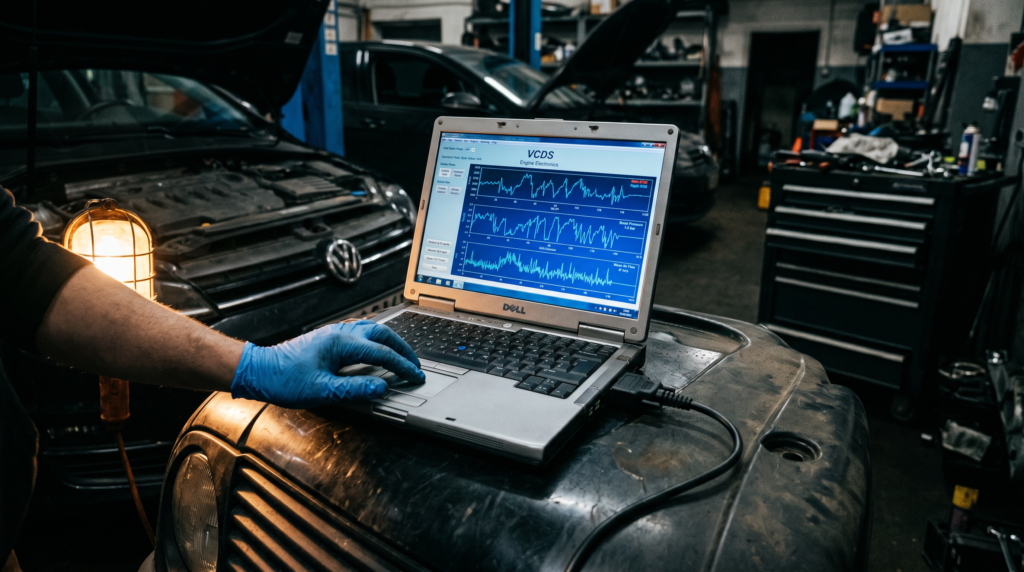
The two names that matter here are VCDS and ODIS. VCDS from Ross-Tech is the workshop standard for VAG cars, a Windows application paired with a genuine interface that gives full access to fault codes, live data, adaptation, and coding across every module. ODIS is the factory system Audi dealers run, with guided fault finding that walks you through a fault tree step by step.
Both connect through the same 16 pin OBD port under the dash. On a VAG car the CAN bus sits on pins 6 and 14, with power on 16 and ground on 4 and 5. A genuine interface and current software is the whole game here. Clone cables and cracked software miss modules, throw false codes, and can brick a control unit mid write. A credible Audi diagnostic service runs genuine hardware and keeps the software current, because a half read scan is worse than no scan at all.
Common Faults a Full Audi Diagnostic Service Catches
Plenty of Audi problems look mysterious until the right tool is on them. A few that a deep scan sorts out quickly:
- Intermittent misfires traced to one cylinder through live misfire counters, not guesswork on coils and plugs.
- DSG and S tronic faults read straight from the mechatronic unit, including clutch temperature and pressure data.
- EPC and limp mode where the real trigger sits in the throttle body, brake light switch, or a torque monitoring fault.
- AdBlue and SCR faults on TDI models, which often need live data and adaptation, not just a cleared code.
- Camera and radar calibration after a windscreen swap, which the comfort and assist modules will flag until done properly.
- Water damaged comfort modules that throw a scatter of unrelated codes across the whole car.
In every one of those cases the code is a starting point. The fix comes from reading the live data and adaptation values that only a full Audi diagnostic service exposes.
Can an Audi Diagnostic Service Be Done Remotely?
More than most owners expect. With a supported interface plugged into the OBD port and a laptop online, a technician can run a full scan, read every module, log live data, and clear or recode faults from anywhere. This is honest about its limits, so here is the split.
Done remotely without trouble: full fault reading across all modules, clearing codes, coding changes, adaptation, retrofit activation, and a lot of fault finding. Our remote VAG programming service handles these every day, often while you sit in the car on your own driveway.
Needs hands on the car: physical repairs, anything that requires measuring a circuit with a meter, and certain security functions tied to GeKo and immobilizer access that may need online OEM authorization. Even then, remote diagnosis usually pinpoints the job before anyone picks up a tool, which saves a workshop hours of chasing and saves an owner from paying for them.
Getting the Right Audi Diagnostic Service
If your car has a fault that a generic scan could not explain, the next step is a proper Audi diagnostic service that reads every module, captures live data, and checks coding and adaptation, not just the one code a cheap reader spat out. If you run a workshop, the same applies when a job exceeds what your current tool can reach. A specialist Audi diagnostic service can drop in as your remote partner, read the car, and hand you the answer plus the coding to back it up.
Either way, the goal is the same. Stop replacing parts on a hunch. Read the car properly, once, and fix what the data actually points to. That is what a real Audi diagnostic service delivers, whether it happens on a bench in front of you or over a secure remote session anywhere in the world.
Is Your VAG Vehicle Showing This Issue?
Whether you are a car owner dealing with a fault, a workshop needing a specialist partner, or an enthusiast looking to unlock your vehicle’s full potential, VAG Programming offers expert remote and in-person ECU coding, programming, and diagnostics for Audi, Volkswagen, Porsche, Bentley, and Lamborghini worldwide.
Contact us today and let’s fix it the right way.