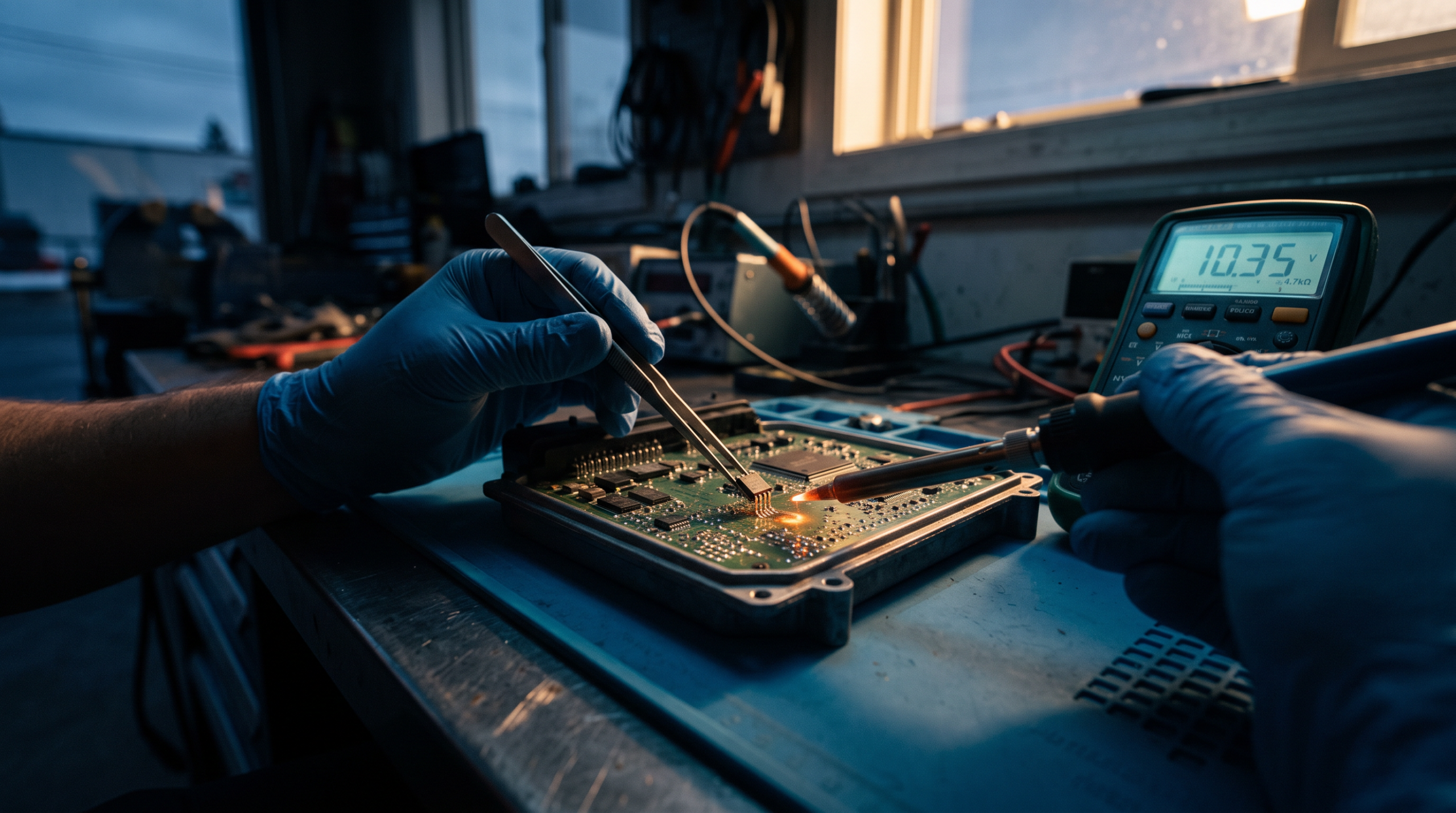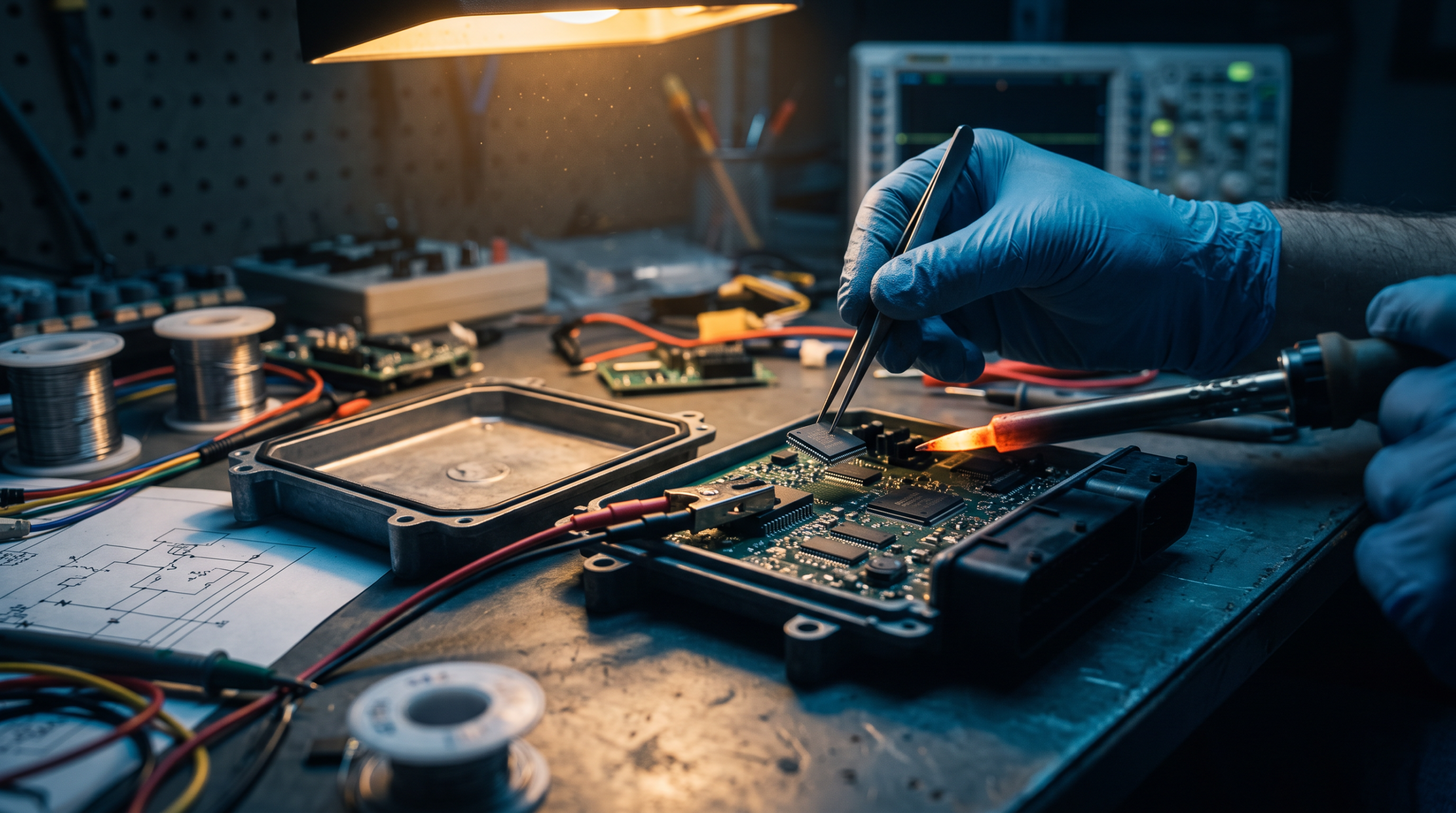
If your Porsche has thrown a Porsche P1128 fault code long term fuel trim warning, the engine control unit is telling you it has run out of room to correct the air-fuel mixture on bank 1. In plain terms, the DME (Porsche’s name for the engine ECU) has been adding more and more fuel to keep the mixture balanced, it has hit its learned correction limit, and it has stored the fault. P1128 is a lean code. The computer sees too much air for the fuel it is delivering, and it can no longer compensate on its own.
This guide covers what the code means, what causes it on Porsche engines, the symptoms you feel from the driver’s seat, and how the repair actually goes. Whether you are an owner staring at a Check Engine Light or a workshop tech chasing a stubborn trim, the Porsche P1128 fault code long term fuel trim points to the same core problem: unmetered air, weak fuel delivery, or a sensor reading wrong.
What the Porsche P1128 fault code long term fuel trim actually means
Every modern Porsche runs closed-loop fuel control. The oxygen (lambda) sensors ahead of the catalytic converters report whether the exhaust is rich or lean, and the DME trims the injector pulse to hold the mixture near stoichiometric, roughly 14.7 to 1. There are two layers to this. Short term fuel trim (STFT) is the instant, moment-to-moment adjustment. Long term fuel trim (LTFT) is the learned average the DME stores in adaptation memory so it does not start from zero every time you drive.
P1128 lives on the long term side. In VAG and Bosch systems, which Porsche shares at the software level, this code is the multiplicative long term fuel trim for bank 1 reading system too lean. Ross-Tech, the company behind the VCDS diagnostic platform, documents the matching VAG number as 17536, and you can cross-reference the measuring blocks on their site at ross-tech.com. Multiplicative means the correction scales with airflow, so it matters most under load and at higher rpm, not just at idle. When that learned factor drifts past the DME limit, usually around plus 25 percent, the Porsche P1128 fault code long term fuel trim gets stored and the lamp comes on.
That is the key diagnostic clue. A multiplicative lean fault steers you toward problems that grow with airflow: a mass air flow sensor reading low, a fuel pump that cannot keep up when you open the throttle, or a large air leak. A small idle-only vacuum leak tends to trip the additive codes instead. Knowing which bucket you are in saves hours of guessing.
What causes the Porsche P1128 fault code long term fuel trim
The lean condition has a short list of usual suspects. Some are shared across the whole VAG family, and some are specific to the flat-six and V engines Porsche builds.
- Mass air flow sensor under-reading. A contaminated hot-film MAF reports less air than is really entering. The DME fuels for the low number, the mixture goes lean, and LTFT climbs. At idle these engines usually pull around 2 to 5 grams per second. A MAF reading well below that at a known rpm is a strong lead.
- Unmetered air. Any air that sneaks in after the MAF is air the DME never counted. Cracked intake boots, a leaking brake booster hose, split vacuum lines, or a failed crankcase breather all do it.
- Fuel delivery shortfall. A tired in-tank lift pump, a clogged fuel filter, or a weak high-pressure pump on direct-injection engines starves the rail under load. Low-side feed pressure usually sits near 5 to 6 bar. The high-pressure side on DFI motors can run from about 50 bar at idle to 150 bar or more under demand. Drop below spec and the engine leans out exactly where P1128 lives.
- Worn or clogged injectors. They deliver less than the DME commands, and the trims climb to make up the gap.
- Exhaust leak before the sensor. A leak upstream of the lambda sensor pulls fresh air in, the sensor reads lean, and the DME adds fuel the engine does not actually need.
The Porsche-specific culprits
On the flat-six engines the air-oil separator (AOS) is a prime suspect for any lean mixture fault. When its internal diaphragm tears, it pulls unmetered air straight into the intake and skews the trims, often with a puff of blue smoke and a rough idle alongside. It is one of the first things an experienced Porsche tech checks when the Porsche P1128 fault code long term fuel trim shows up on a 911, Boxster, or Cayman.
Direct fuel injection, which Porsche rolled out across the range from around 2009, adds two more. Carbon builds up on the intake valves over the years because fuel no longer washes over them, and that changes how the port flows. The high-pressure fuel pump also wears, and a weak one cannot hold rail pressure when you accelerate. Both push the long term fuel trim lean under load, which is exactly the multiplicative signature this code describes.
Symptoms you will notice
Sometimes the only sign is the Check Engine Light. A mild lean condition can sit under the surface while the DME quietly compensates, right up until it runs out of trim. As it gets worse you feel it:
- Check Engine Light on, usually steady rather than flashing
- Hesitation or a flat spot when you accelerate
- Rough or hunting idle
- Down slightly on power with lazy throttle response
- Occasionally higher fuel consumption as the DME dumps in extra fuel
- Harder cold starts when fuel delivery is the root cause
If the mixture goes lean enough, you can trip misfires too, and that is when a mild annoyance turns into something that can cook a catalytic converter. Do not sit on it for months.
Related codes that appear with the Porsche P1128 fault code long term fuel trim
P1128 rarely travels alone. The codes stored next to it tell you a lot about where to look:
- P0171, System too Lean, Bank 1. The generic OBD-II twin of P1128. A scanner often logs both together.
- P0174, System too Lean, Bank 2, on the V-configuration engines. Lean on both banks points to something shared, like fuel supply, rather than a single leak.
- P1136 and P1137, the additive long term fuel trim faults. If the additive and multiplicative codes are both set, the problem is big enough to affect idle and load together.
- P0102, MAF circuit low input, which backs up a failing air flow sensor.
- P0300 series misfire codes, common once the mixture goes far enough lean.
Reading the full fault memory and the live fuel trim data together, rather than one code in isolation, is how a good tech separates a MAF problem from a fuel-supply problem. This is core vehicle diagnostics and troubleshooting work.
How the Porsche P1128 fault code long term fuel trim gets fixed
The repair follows the evidence. Guessing at parts on a Porsche gets expensive fast, so the order matters.
First, read live data. Look at STFT and LTFT across idle and load. Watch the MAF grams-per-second figure and compare it to what the engine should be pulling. Check fuel pressure on both the low and high side on DFI engines. A smoke test of the intake finds leaks the eye misses. On a flat-six, inspect the AOS early. These steps usually name the culprit without throwing money at it.
Then fix the root cause: clean or replace the MAF, seal the leak, replace the failing pump or filter, sort the AOS, or clean the injectors and valves. After the mechanical repair, the DME adaptation has to be reset so the engine relearns its fuel trims from a clean baseline. Skip that step and the old lean correction stays in memory and can re-trigger the Porsche P1128 fault code long term fuel trim even though the hardware is now fine. On VAG-family cars this reset runs through VCDS or ODIS. On Porsche it runs through PIWIS or an equivalent pass-through tool.
Now and then the DME itself needs attention. Porsche issues software updates that refine mixture adaptation, and a car on old firmware can chase its own tail. That is where ECU programming and coding services come in, whether the module needs a fresh flash, a calibration update, or a full replacement coded to the car. You can check the current model range on Porsche’s own site at porsche.com.
Remote diagnosis and when to call a specialist
Let me be straight about what can and cannot be done from a distance. Finding the mechanical fault, the smoke test, the fuel pressure gauge, the physical MAF inspection, needs the car in front of someone. That part is hands-on. A large slice of the job is not.
Reading the full fault memory, pulling live fuel trim and lambda data, resetting adaptations, updating DME software, and coding a replacement module can all be handled through a remote VAG programming service. If your local shop can do the mechanical work but cannot get into the Porsche software properly, that is exactly the gap we fill, anywhere in the world. Porsche fuel-trim work sits at the more complex end of VAG diagnostics, and only a handful of independent specialists are set up to handle the coding side correctly.
Here is the bottom line on the Porsche P1128 fault code long term fuel trim. It is a lean fault the DME can no longer correct. It is almost always unmetered air, weak fuel delivery, or a lying sensor. And it is very fixable once you read the data instead of guessing. Get the diagnosis right, repair the root cause, reset the adaptations, then confirm the trims settle back near zero. Do that, and the light stays off for good.
Is Your VAG Vehicle Showing This Issue?
Whether you are a car owner dealing with a fault, a workshop needing a specialist partner, or an enthusiast looking to unlock your vehicle’s full potential, VAG Programming offers expert remote and in-person ECU coding, programming, and diagnostics for Audi, Volkswagen, Porsche, Bentley, and Lamborghini worldwide.
Contact us today and let’s fix it the right way.