
If your Porsche cranks but will not fire, and a small red key or lock symbol is glowing in the cluster, you are almost certainly looking at an immobilizer problem. A porsche immobilizer fault code fix starts with one simple idea: the engine control unit (Porsche calls it the DME, short for Digital Motor Electronics) will not release fuel and spark until it receives a valid ‘start enable’ handshake from the immobilizer. Break that handshake anywhere along the chain and the car goes dead quiet, even though the starter spins and the battery reads fine.
This guide covers what the code actually means, what causes it on each Porsche platform, the symptoms you feel from the driver seat, and what a proper porsche immobilizer fault code fix involves in the workshop. It is written for both the owner standing next to a no-start car and the technician deciding whether this is a key, a cluster, or a component protection job.
What the immobilizer fault code actually means
The Porsche immobilizer (Wegfahrsperre in the factory literature) is a small security network, not a single box. It has four players: the transponder chip inside the key, the antenna ring wrapped around the ignition switch that reads that chip, the immobilizer control unit (on many Porsches this lives inside the instrument cluster, on keyless cars it sits in the Kessy access module), and the DME. When you turn the key or press start, the cluster or Kessy reads the transponder, checks it against stored key data, then sends an encrypted authorization to the DME over the CAN bus. No valid message, no engine.
So an immobilizer fault code is the system telling you one of those handshakes failed. On Porsche’s factory PIWIS tester the fault usually shows as a DME or Kessy entry worded like ‘immobilizer: no signal’, ‘no authorization received’, or ‘component protection active’. On the VAG-platform Porsches such as the Cayenne and Macan you can read the same faults in Ross-Tech VCDS under address 25 (immobilizer), address 05 (access and start, the Kessy), and address 17 (instruments). Ross-Tech publishes solid reference material for reading these, and their documentation at ross-tech.com is a good starting point for the VCDS side.
Why a porsche immobilizer fault code fix depends on the platform
Porsche is not one architecture, so the right porsche immobilizer fault code fix changes with what you are working on.
- 911 (996, 997) and Boxster / Cayman (986, 987): the instrument cluster is the immobilizer master. It stores the key data and talks straight to the Bosch Motronic or later DFI DME. A failing cluster is a common root cause on these cars.
- Cayenne (955, 957, the 9PA): built on the PL71 platform shared with the VW Touareg and Audi Q7. The immobilizer runs through the Kessy and cluster on CAN, so it behaves like a VAG immobilizer with all the same quirks.
- Macan (95B) and Panamera: MLB-era cars with heavy component protection. The immobilizer data is tied to the VIN across the cluster, Kessy and DME, which makes any module swap a coding job, not a plug-and-play job.
That platform split is the biggest reason a Porsche immobilizer issue is harder than the same fault on a Golf. These are lower-volume cars, the security data is better protected, and the correct tooling is not something every corner shop owns. It is also why remote diagnosis is genuinely useful here, and something we do often.
Symptoms the driver actually notices
From the seat, an immobilizer fault is usually obvious once you know the pattern:
- The engine cranks at normal speed but never catches. No stumble, no cough, just cranking.
- A red key, lock, or car-with-key symbol in the cluster, sometimes flashing.
- The car ran fine yesterday and is completely dead-start today, often after a battery change, a jump start, or a key that got wet.
- Intermittent no-starts that clear when you lock and unlock, or swap to the spare key.
One detail matters more than any other before you spend money: check the battery. A resting voltage below about 12.4 volts, or a pack that collapses under 11.8 volts while cranking, will drop CAN modules offline and throw immobilizer and component protection faults that are not real. I have seen a full porsche immobilizer fault code fix turn out to be a three year old battery. Always load-test and charge first.
What causes it, most to least common
Once the battery is ruled out, the usual suspects are:
- Key transponder failure. Dropped keys, water intrusion, and worn blades kill the chip. The remote may still lock the doors while the transponder is dead, which confuses owners.
- Antenna ring around the ignition. The reader coil cracks or its wiring chafes, so a good key never gets read.
- Instrument cluster faults. On the 997 and Cayenne especially, the cluster is the immobilizer brain, and a failing cluster takes the system down with it.
- A replaced or repaired module. Fit a used DME, cluster or Kessy from another car and it arrives carrying the donor VIN and donor key data. The car will not authorize until the immobilizer is re-adapted.
- Component protection. This is the VAG and Porsche security layer (Bauteilschutz) that locks a module to one specific car. Until it is cleared and re-adapted through the online server, the module stays locked even when everything else is perfect.
What the porsche immobilizer fault code fix involves
Here is how a clean job runs in the bay. First, read the full fault memory across the DME, cluster and Kessy, not just one module, because the real cause often hides in a neighbor. Confirm battery and charging. Check the transponder and antenna ring with the key in hand. If the hardware is good, the fix moves into software.
When a module has been swapped, the porsche immobilizer fault code fix means re-marrying the modules: aligning the immobilizer data so the cluster, Kessy and DME all agree on the same car and the same keys, then clearing component protection through Porsche’s online system so the new part is authorized. This is dealer-level access, and it is exactly what our ECU programming and coding services and our key and immobilizer programming cover. If keys were lost or you need a spare added, that is key programming against the car’s stored security data, done at the same time.
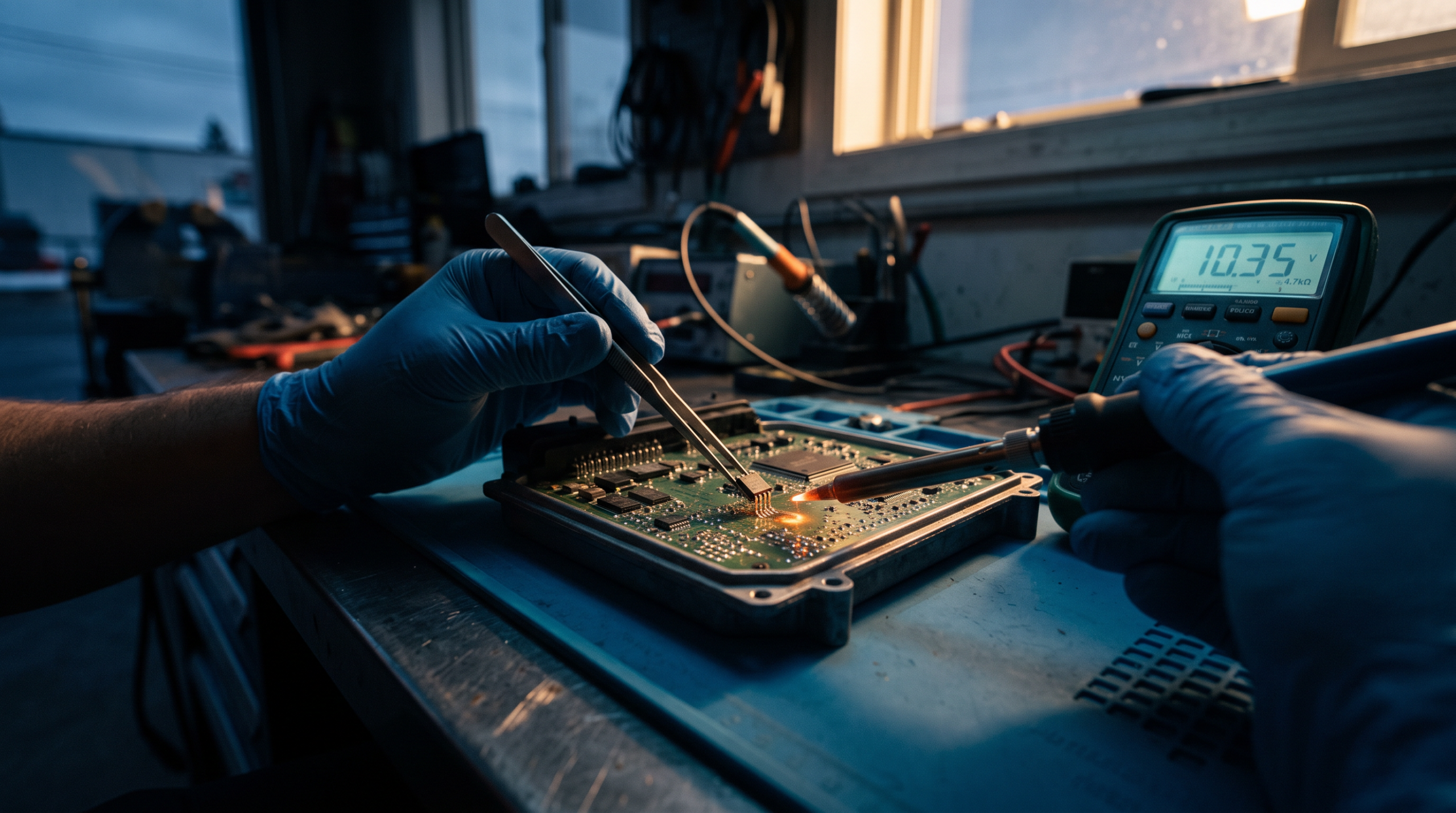
Some jobs go deeper. If a cluster or DME is truly dead, the immobilizer data (the component security value and the key data) sometimes has to be read directly from the chip on the bench with EEPROM or BDM tools, then written into the replacement. That is hands-on work and cannot be done down a phone line.
Related fault codes that show up alongside
An immobilizer problem rarely travels alone. When you scan the car, expect to also see:
- Component protection active or ‘component protection not adapted’ entries in the DME and Kessy.
- CAN communication faults (U-codes, or ‘no communication with immobilizer’) when a module has dropped offline.
- Instrument cluster internal faults on cars where the cluster is the immobilizer master.
- Terminal 15 or low-voltage entries that point straight back to a weak battery.
Reading them together tells the story. A lone immobilizer code with a fistful of U-codes usually means a communication or power problem, not a bad key. A clean bus with a single ‘no authorization’ entry and a component protection flag usually means a module was swapped.
Can it be fixed remotely?
Honest answer: a lot of it, yes. The coding side of a porsche immobilizer fault code fix, meaning immobilizer adaptation, component protection removal, and most key and module coding, can be done remotely. You or your local shop plug a supported pass-through interface into the OBD port under the dash, we connect over the internet, and we run the same procedures a dealer would. Our remote VAG programming service handles Porsche the same way it handles Audi and VW, worldwide, which matters because few independents carry proper Porsche immobilizer access. Porsche’s own owner resources at porsche.com will point you to a dealer, but a specialist can often solve it over a connection for less cost and less waiting.
What cannot be done remotely is the physical work: cutting a key, fitting a transponder, replacing an antenna ring, or bench-reading a dead cluster. For those you need the car, or the module, in front of a technician.
The bottom line
A porsche immobilizer fault code fix is rarely a random gremlin. It is a broken authorization handshake, and the job is finding which link failed: the key, the antenna, the cluster, the wiring, or a module that was swapped without coding. Start with the battery, read every module instead of one, and match the fix to the platform. Get those three right and most of these cars come back to life quickly. When the fault points at coding, component protection, or immobilizer adaptation, that is specialist territory, and it is what we handle every day, in person or remotely, for Porsche owners and workshops anywhere in the world.
Is Your VAG Vehicle Showing This Issue?
Whether you are a car owner dealing with a fault, a workshop needing a specialist partner, or an enthusiast looking to unlock your vehicle’s full potential, VAG Programming offers expert remote and in-person ECU coding, programming, and diagnostics for Audi, Volkswagen, Porsche, Bentley, and Lamborghini worldwide.
Contact us today and let’s fix it the right way.