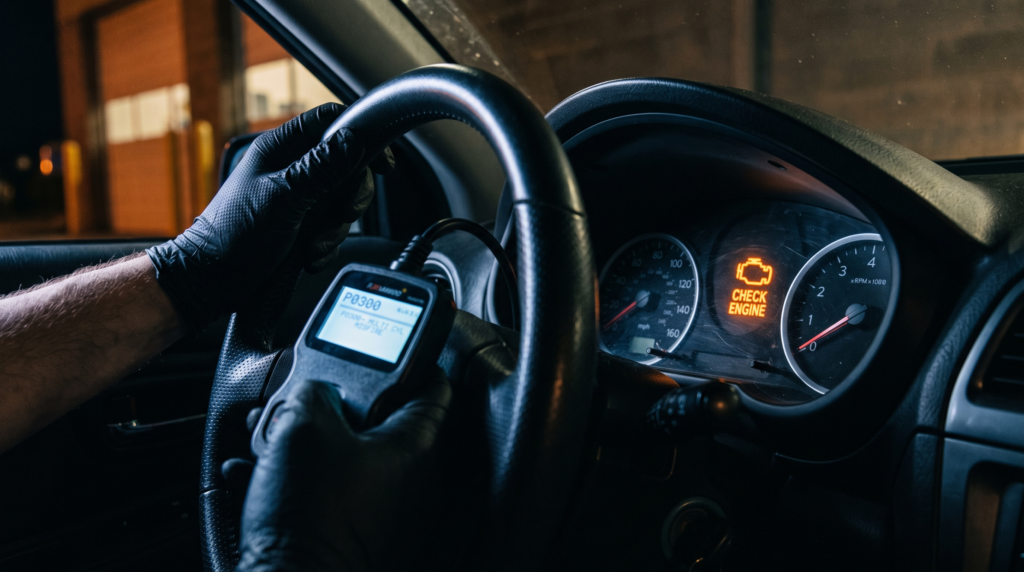
If your Audi or VW is shaking at idle and throwing a P0300 code, the engine control unit has detected a random or multiple cylinder misfire it cannot tie to one specific cylinder. That is the short version. The longer version, the one that actually gets you back on the road, is understanding the P0300 random misfire Audi VW cause and fix for your exact platform. On modern VAG engines like the EA888 2.0T and the EA211 1.4T, this code rarely points to one failed part. It points to a chain of related faults that the ECU reads as misfire events spread across the cylinders.
What the P0300 random misfire Audi VW cause and fix really involves
First, the basics. P0300 is the generic random misfire code. P0301 through P0308 are cylinder-specific, so P0301 is cylinder 1 and P0304 is cylinder 4. When you see P0300 on its own, the misfire is either jumping between cylinders or hitting several at once. The ECU watches crankshaft speed hundreds of times per revolution. When a cylinder fails to fire cleanly, the crank decelerates for a fraction of a millisecond, and the ECU adds to the misfire counter for that cylinder. Cross the threshold and you get the code plus a Check Engine Light. If that light is flashing, stop driving. A flashing CEL means raw fuel is washing into the catalytic converter, and a 1,500 dollar cat is not worth the gamble.
The reason the P0300 random misfire Audi VW cause and fix deserves its own write-up is that VAG direct-injection engines share a handful of well-known failure points that all surface as this one code. Get the diagnostic order right and the repair is straightforward. Guess at it and you throw parts at the car for weeks.
Common causes behind a P0300 random misfire on Audi and VW
Here is what we actually find on the bench, roughly in order of how often it shows up:
- Ignition coils. The single most common cause. VAG coil-on-plug units fail with heat and age, usually one at a time. A failing coil throws a random misfire that wanders as the ECU compensates. A full set of four coils for a 2.0T runs about 120 to 200 dollars in parts.
- Spark plugs. Worn or wrong-gap plugs. Turbo VAG engines want a tight gap, typically 0.7 to 0.8 mm, and a colder heat range than people expect. The wrong plug off a parts-store shelf will misfire under boost.
- Carbon buildup on intake valves. FSI and TSI direct-injection engines do not wash the back of the intake valves with fuel. Carbon cakes up over 60,000 to 80,000 miles, disrupts airflow, and causes cold-start misfires. The fix is walnut-shell blasting, an in-person job.
- Vacuum and boost leaks. A torn PCV diaphragm, very common on the EA888, plus a cracked charge pipe or a leaking intake manifold gasket, leans out the mixture and triggers misfires. This almost always drags P0171 along with it.
- Fuel delivery. Clogged high-pressure injectors, a worn high-pressure fuel pump cam follower, or low rail pressure. These tend to misfire under load rather than at idle.
- Timing chain stretch. Early EA888 Gen 1 and Gen 2 engines suffer tensioner failure and chain stretch. Cam timing drifts and you get misfires alongside P0011 or P0016.
Notice that a real P0300 random misfire Audi VW cause and fix is a process of elimination, not a single answer. The same code on a 2010 Audi A4 with a stretched chain and a 2018 Golf with a dead coil calls for two completely different repairs.
Symptoms you actually feel from the driver’s seat
You do not need a scanner to know something is off. Drivers describe a rough, lumpy idle, a steering-wheel shake at a stop, hesitation or a flat spot on acceleration, and a clear drop in fuel economy. Some smell unburned fuel. Hard starting, especially on a cold morning, leans toward carbon or fuel-side problems. A misfire that only appears under hard acceleration usually means coils or fuel pressure giving up when cylinder pressure is highest.
The professional P0300 random misfire Audi VW cause and fix procedure
This is where proper tooling separates a clean repair from a guess. Even though P0300 is the random code, a quality scan tool reads the individual misfire counters for every cylinder. We connect VCDS or ODIS and watch the live misfire count in the measuring blocks while the engine runs. If cylinder 3 is logging 4,000 counts and the rest sit near zero, the random code is really a cylinder 3 problem, and we have just saved you three coils. The official Ross-Tech VCDS documentation explains exactly how to pull these counters on VAG control modules.
From there the order is logical. Check fuel trims for a lean condition that signals a vacuum leak. Move the suspect coil to a different cylinder and see if the misfire follows it. Read the actual high-pressure fuel rail value against the commanded pressure. Inspect the PCV and run a quick boost-leak test. Our vehicle diagnostics and troubleshooting process walks through this exact sequence so we replace the part that is genuinely broken, not the part that is easy to reach. A thorough P0300 random misfire Audi VW cause and fix almost always ends with a confirmed root cause before a single bolt comes loose.
When the fix is mechanical and when it is software
Most of the P0300 random misfire Audi VW cause and fix work is hands-on: coils, plugs, carbon cleaning, a charge pipe, an injector. But software matters more than people assume. After new injectors go in, their injector codes must be written to the ECU so it trims fuelling correctly. After a high-pressure pump or a throttle body, adaptations need resetting. And if the ECU itself was swapped or repaired, VAG component protection has to be cleared or the car will not run right. When your repair touches the control unit, our ECU programming and coding services handle the coding side so the mechanical fix actually holds.
Related codes that show up with P0300
P0300 rarely travels alone. The codes sitting next to it are your best diagnostic clue:
- P0301 to P0308: cylinder-specific misfires. If these appear with P0300, start at the named cylinder.
- P0171 / P0174: system too lean. Points hard at a vacuum or boost leak, often the PCV.
- P0011 / P0016: camshaft timing. Suspect chain stretch on older EA888 engines.
- P0087: fuel rail pressure too low. A classic fuel-delivery misfire.
- P052E: PCV regulator performance, another lean-misfire pointer.
Reading the full list together is the fastest route to a correct P0300 random misfire Audi VW cause and fix. A misfire with P0171 is a leak. A misfire with P0016 is timing. A misfire on its own at idle is usually ignition.
Can a P0300 misfire be diagnosed remotely?
Partly, and it is genuinely useful. We cannot swap your coils over the internet, but we can run a live remote session, read your misfire counters and fuel trims, interpret the freeze-frame data, and tell you the exact cylinder and system to target before you or your local shop touch a wrench. For coding tasks after a repair, injector coding, adaptations, and component protection, the whole job is done remotely. Our remote VAG programming service connects to cars worldwide, so you are not stuck with whatever dealer happens to be nearby. For the official background on these engines, owners can also check Audi’s official site.
The honest split is simple. Physical parts are local, the brain work and the software are remote. Plenty of our customers get the diagnosis from us, hand the parts job to a trusted local mechanic, then come back to us for the coding. That combination is often the fastest and cheapest path to a real P0300 random misfire Audi VW cause and fix.
Getting it fixed right the first time
A P0300 on an Audi or VW is not a mystery, it is a sequence. Read the per-cylinder counters, check the trims, confirm the root cause, then repair and code. Run in that order, the P0300 random misfire Audi VW cause and fix is a same-day job on most MQB platform cars. Run on guesswork, it turns into a parts cannon that drains your wallet. Whether you are an owner who wants a straight answer or a workshop that needs a reliable VAG coding partner, the correct diagnosis is what makes the repair stick.
Is Your VAG Vehicle Showing This Issue?
Whether you are a car owner dealing with a fault, a workshop needing a specialist partner, or an enthusiast looking to unlock your vehicle’s full potential, VAG Programming offers expert remote and in-person ECU coding, programming, and diagnostics for Audi, Volkswagen, Porsche, Bentley, and Lamborghini worldwide.
Contact us today and let’s fix it the right way.