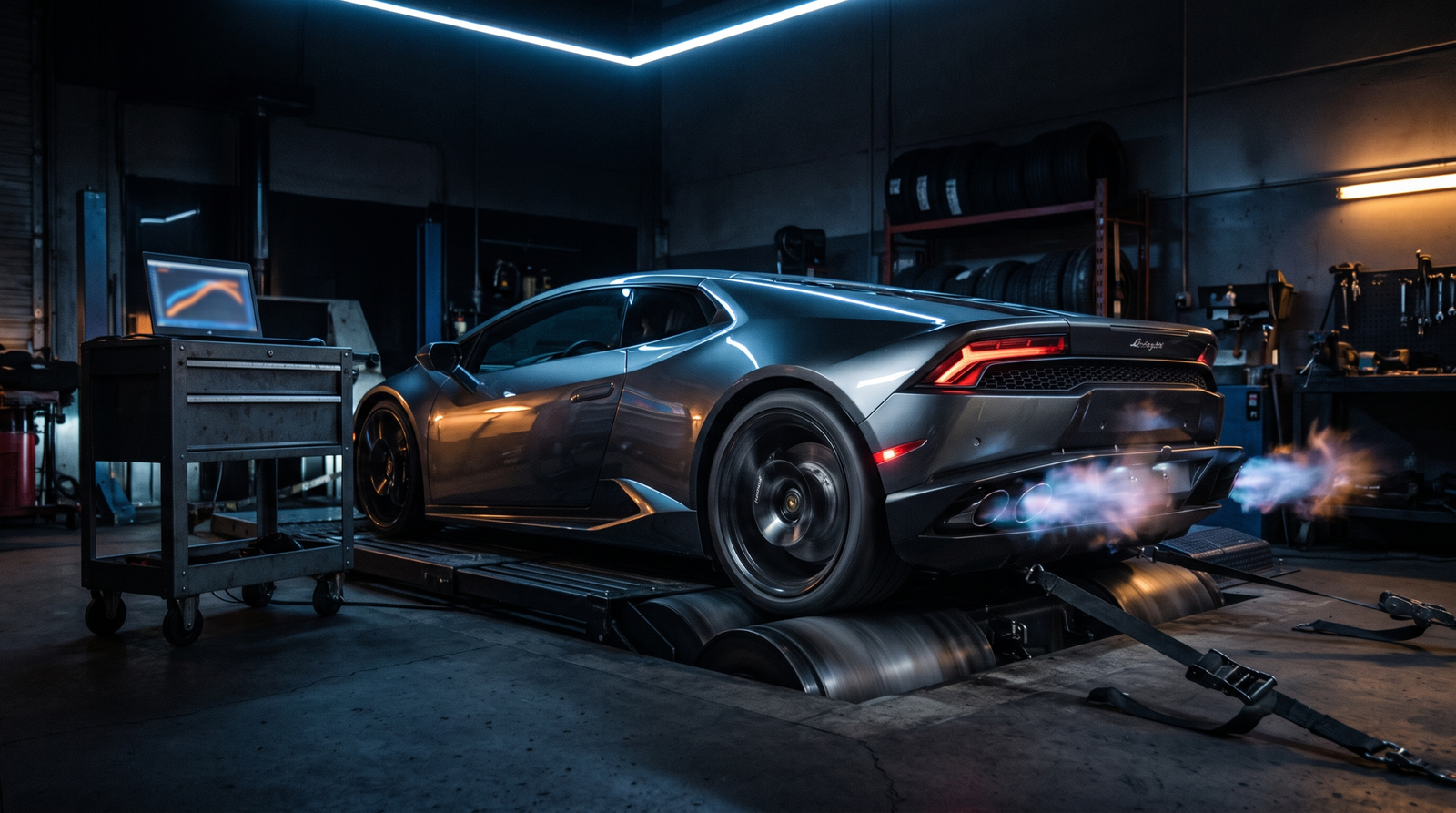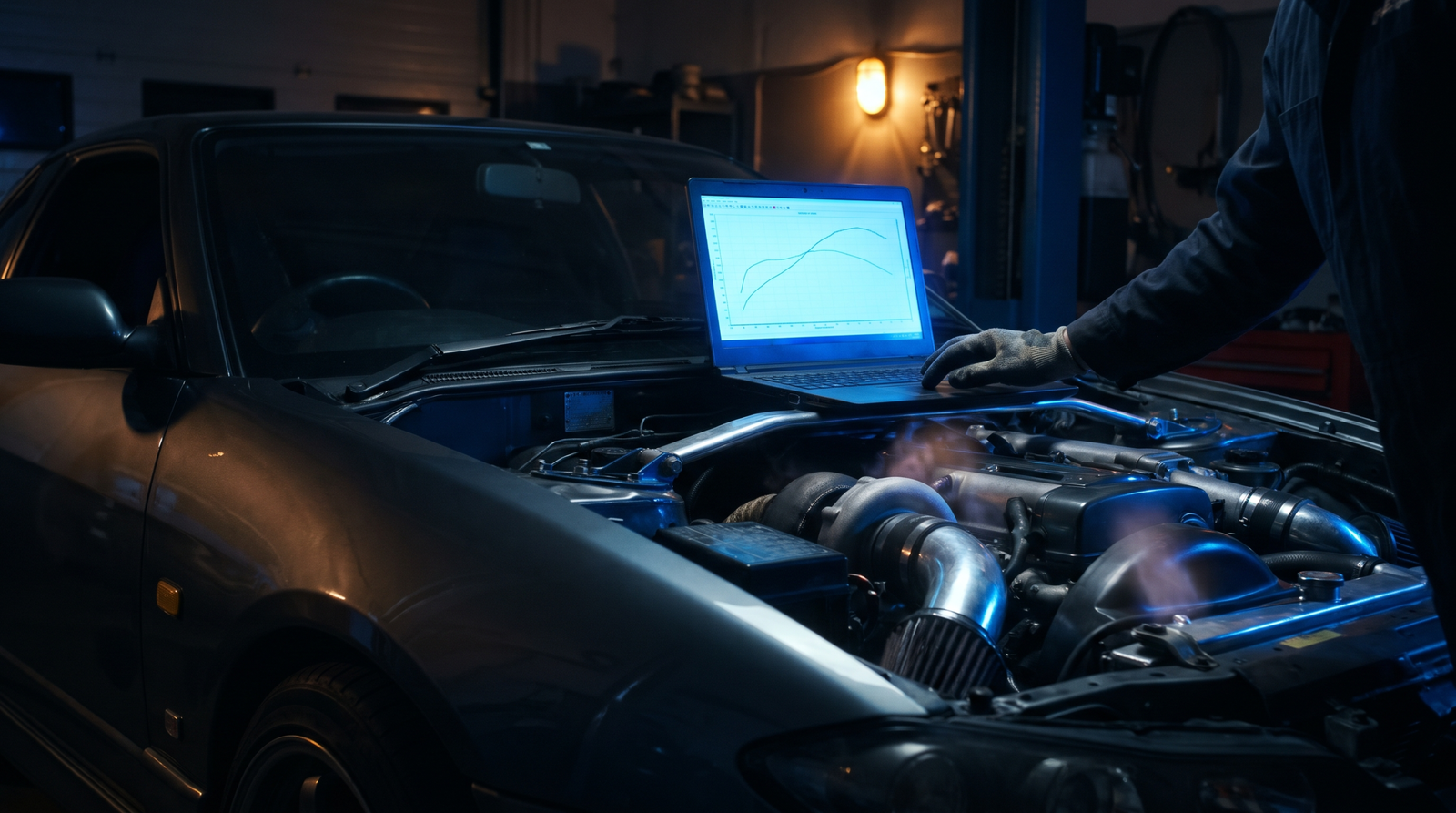
A Lamborghini performance tuning ECU remap does two very different jobs depending on which car you own. On the naturally aspirated V10 and V12 cars, the Gallardo, Huracán and Aventador, the factory calibration is already close to the edge, so a remap sharpens throttle response, cleans up the torque curve and buys you 15 to 30 hp at best. On the twin-turbo Urus, the same work routinely adds 100 to 130 hp and around 150 to 200 Nm. Anyone promising big numbers on a stock Huracán from software alone is selling you a feeling, not horsepower.
This article explains what actually changes inside the engine controller, what the transmission controller can add, the real-world gains we trust, and the risks you accept. It is written for an owner who wants the car to feel sharper and knows the difference between a dyno sheet and a marketing claim. Lamborghini performance tuning ECU work is rare enough that very few independent shops worldwide do it properly, and that rarity is exactly why you should understand the process before you hand over the keys.
What a Lamborghini Performance Tuning ECU Remap Actually Changes
Every modern Lamborghini runs Bosch engine management. The Huracán uses two Bosch MED17.1.1 controllers, one per cylinder bank, in a master and slave arrangement inherited from the Audi R8. The Gallardo used a pair of earlier Bosch ME7 and later MED9 generation units depending on the year. The Urus runs a single Bosch MG1CS008, the same controller fitted to the 4.0 TFSI EA825 V8 in the Porsche Cayenne Turbo, the Audi RS 6 and the Bentley Continental GT V8. That shared hardware is why a tuner with deep VAG platform experience can work on these cars at all.
Inside the file, a Lamborghini performance tuning ECU calibration touches a known set of tables:
- Torque model and limiters. The ECU does not think in horsepower. It thinks in requested torque, and every limiter in the car is a torque cap. Raising power starts here.
- Ignition timing. Advance is added where knock margin allows, usually a degree or two in the mid range on the V10, more on the Urus once boost rises.
- Fuel and lambda targets. Richer wide open throttle targets protect the catalysts and pistons under higher load, typically around 0.80 to 0.85 lambda at peak power on the turbo V8.
- Boost pressure (Urus only). Wastegate duty and target boost tables move up, usually by 0.2 to 0.3 bar for a Stage 1 file.
- Throttle mapping. The pedal to throttle plate relationship is recalibrated per drive mode so Strada feels less lazy without making Corsa twitchy.
- Rev and speed limiters. The top speed limiter can be removed. The rev limiter should move very little, if at all, on a V10 that already spins to 8,500 rpm.
Every change ends with a checksum correction. Both Huracán controllers must receive matched files, or the two banks will run different maps and the car will throw synchronisation faults. This is the kind of detail that separates proper ECU programming and coding services from a generic file emailed to anyone with a flashing cable.
Naturally Aspirated V10 and V12: Honest Numbers
The 5.2 litre V10 in the Huracán makes 610 PS in the LP610-4 and 640 PS in the Performante, EVO, STO and Tecnica. The 6.5 litre V12 in the Aventador climbed from 700 PS to 780 PS in the Ultimae across its life. These engines run high compression, combined direct and port injection on the Huracán, and factory calibrations developed with almost no fuel economy compromise. There is no boost to turn up.
So what does software alone deliver? On a stock Huracán, expect 15 to 25 hp and a flatter mid range, mostly from timing and throttle mapping. Add equal length headers, high flow catalysts and a matched file, and 30 to 50 hp over stock becomes realistic because the ECU can now use the extra airflow and the rear oxygen sensor monitoring can be recalibrated for the new cats. The gain you will notice most is not peak power. It is the way the car responds to a small pedal input at 4,000 rpm in Sport mode.
Where the real gains come from on a Huracán or Aventador
Forced induction is the only route to serious power on these engines. Supercharger kits for the Huracán push past 800 hp and twin-turbo builds with forged internals run four figures. Every one of those packages lives or dies on the calibration. Fuel delivery, boost control through an external controller, knock strategy and the torque model all have to be rewritten, and the stock Lamborghini performance tuning ECU file becomes the starting point, not the end point. That is bench work with a dyno, not a remote flash.
Urus: Where Lamborghini Performance Tuning ECU Work Pays Off
The Urus is a different animal. Its 4.0 litre twin-turbo V8 leaves the factory at 650 PS and 850 Nm, or 666 PS in the S and Performante, and the MLB evo platform underneath is shared with the Audi RS Q8 and the Porsche Cayenne Turbo. Those sister cars run the same engine at different outputs, which tells you the hardware has headroom. A conservative Stage 1 file takes the Urus to roughly 750 to 780 hp and about 1,000 Nm. Stage 2 with high flow downpipes and an upgraded intake sits around 800 hp on 98 RON fuel.
The MG1CS008 is a secured controller. Most tools need a one-time bench unlock, where the ECU is read in service mode on the bench, and after that it can be flashed through the OBD port. That first step has to happen in person or with the ECU shipped to the tuner. Once it is unlocked, map revisions and returns to stock can be done remotely with a flashing interface at your end and the tuner on the other end of the connection.
Heat is the enemy on a tuned Urus. The stock intercoolers soak quickly on repeated pulls, intake air temperature climbs, and the ECU pulls timing to protect itself. A Lamborghini performance tuning ECU file that ignores this will feel strong for one run and soft for the next three. A good file keeps the boost target realistic, keeps lambda rich enough at peak load, and leaves the knock control fully active. Stage 2 on a Urus should come with an intercooler upgrade or it is a Stage 1 with a louder exhaust.
TCU Tuning: The Half Most Tuners Skip
The engine is only half of the drivetrain, and on a Lamborghini the gearbox controller holds some of the most useful calibration in the car.
The Huracán runs a 7-speed dual-clutch, badged LDF, built by Graziano and closely related to the R8 S tronic. Its TCU controls shift timing, clutch fill pressure, torque intervention during shifts and the launch control strategy Lamborghini calls Thrust Mode. A TCU calibration can cut shift times in Corsa, firm up clutch engagement in Sport, raise the torque clamp so the gearbox stops asking the engine to back off, and reset the launch rpm so Thrust Mode uses the extra torque instead of ignoring it.
The Aventador uses the single-clutch ISR automated manual. The factory quoted 50 millisecond shifts, but the low speed behaviour is famously abrupt. TCU work here is less about speed and more about engagement quality in Strada and Sport, with a sharper Corsa left alone.
The Urus runs a ZF 8-speed torque converter automatic. The TCU holds its own torque limits, and the moment the ECU asks for 1,000 Nm the gearbox controller will intervene unless its tables move too. A Stage 1 Urus can live on the stock TCU with some torque intervention on upshifts. Beyond that, the TCU needs raising to match, and shift firmness, kickdown behaviour and converter lockup can be tuned at the same time. This is why we treat performance ECU and TCU tuning as one job, not two.
Safety, Warranty and Whether the Dealer Will Know
Yes, the dealer can know. Every ECU keeps a flash counter and a software version identifier. The VAG group has flagged modified Audi software with the TD1 marker for years, and Lamborghini dealer diagnostics can read the same evidence. Flashing back to stock before a service restores the factory calibration but does not reset the counter. A tuned Lamborghini is out of factory warranty on the powertrain the moment it is detected, so go in with that decision made, not hoping to hide it.
On the mechanical side, the risks are specific and manageable:
- Rev limiter on the V10 and V12. Leave it alone or move it by 100 to 200 rpm at most. The valvetrain and connecting rods were signed off at the factory limit, not above it.
- Fuel quality on the Urus. A tuned file assumes 98 RON or 93 AKI. Fill with 95 RON and the knock control will pull timing all day, and if the file was built without margin, it will not pull enough.
- Driveline on the Urus. At 1,000 Nm the transfer case, driveshafts and converter are working hard. Stage 2 and above should be a conversation about hardware, not just software.
- Catalyst and oxygen sensor monitoring. Removing cats and simply coding out the rear sensors is a shortcut that fails emissions testing in most regions and hurts resale.
Before and after every flash we log knock retard, intake air temperature, lambda, boost actual against target on the Urus, and shift torque intervention. A Lamborghini performance tuning ECU file that cannot be defended with a datalog is a guess.
Supporting Hardware Worth Having
For the V10 and V12 cars, the hardware that actually moves the needle is exhaust: headers, high flow or sport catalysts and a valved rear section, with the ECU recalibrated to match. An intake helps less than the marketing suggests. For the Urus, the order is fuel quality first, then intercoolers, then downpipes, then intake. Tyres and brake pads deserve a line here too. A Urus at 1,000 Nm will overwhelm worn rubber and you will feel it before you feel the power.
Choosing a Lamborghini Performance Tuning ECU Specialist
Lamborghini is a low volume brand sitting on VAG electronics. The tuner you want understands the Bosch MED17 and MG1 families from the Audi and Porsche side, has the bench equipment for a secured ECU, writes or adapts files rather than reselling them, and can read both the Lamborghini specific modules and the Audi derived ones. Much of the chassis on a Gallardo or Huracán answers to standard VAG diagnostics, which is why tools like Ross-Tech VCDS can read many of their modules, while the engine side still needs professional flashing hardware.
VAG Programming is one of very few independent specialists worldwide who work on Lamborghini engine and gearbox controllers alongside Audi, Porsche and Bentley every week. The practical split is simple. OBD flashing, map revisions, return to stock and TCU updates can be done remotely with a flashing interface on your end. Bench unlocks on the MG1CS008, forced induction calibrations and anything that needs a dyno happen in person.
The Right Way to Tune a Lamborghini
Decide what you want first. If the goal is sharper response and a cleaner torque curve on a Huracán or Aventador, a conservative Lamborghini performance tuning ECU file paired with a TCU calibration delivers more of the feeling you are chasing than any power claim. If the goal is big numbers, buy a Urus or budget for forced induction and a proper build. Either way, insist on a datalog before and after, keep the knock control intact, leave the rev limiter close to stock, and accept the warranty position before you flash.
Independent road testers at Car and Driver have measured stock examples of these cars for years, which gives you a baseline to judge any claim against. If a tuner quotes gains that would make a stock Huracán faster than a Performante from software alone, walk away. A Lamborghini performance tuning ECU remap done properly is measurable, and reversible in everything except the flash counter. That is the standard to hold anyone to, including us, whether the car comes to the bench or the work runs through our remote VAG programming service.
Is Your VAG Vehicle Showing This Issue?
Whether you are a car owner dealing with a fault, a workshop needing a specialist partner, or an enthusiast looking to unlock your vehicle’s full potential, VAG Programming offers expert remote and in-person ECU coding, programming, and diagnostics for Audi, Volkswagen, Porsche, Bentley, and Lamborghini worldwide.
Contact us today and let’s fix it the right way.