
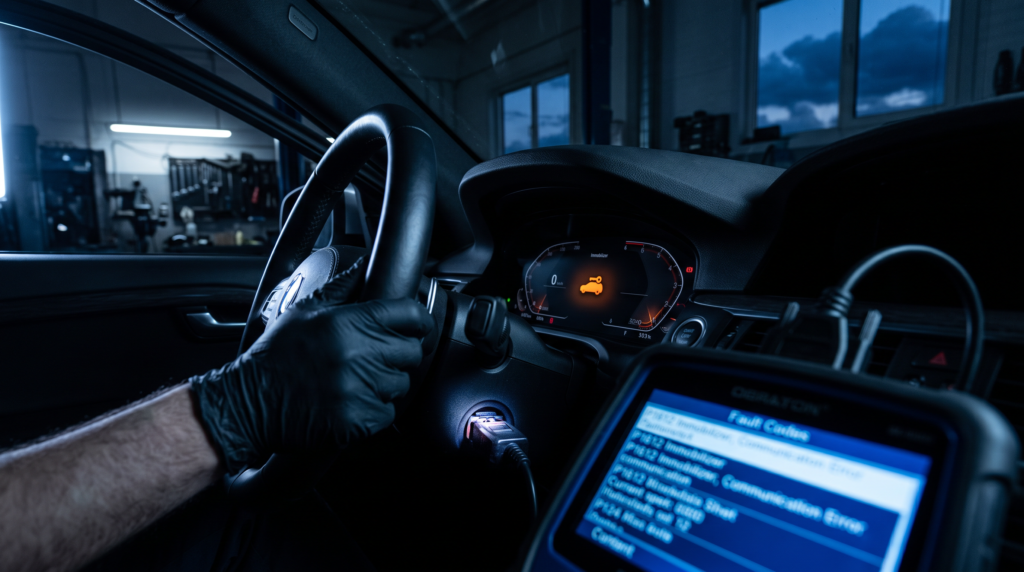
If your Bentley cranks but will not fire, and a small key or padlock symbol flashes in the cluster, the immobilizer has refused to authorize the engine. That is the whole problem in one sentence. The bentley immobilizer active fault fix means getting three parts to agree on the same security data again: the immobilizer control unit, the key transponder, and the engine control unit (ECU). When any one of them loses sync, the car locks fuel and ignition and you get a no-start.
Bentley is rare, but the immobilizer systems under the skin are shared with the wider Volkswagen Group. An early Continental GT sits on VW’s D-platform (the same PL62 architecture as the Phaeton), and cars from 2018 use the MSB platform shared with the Porsche Panamera. The Bentayga rides on MLB Evo. That matters, because the bentley immobilizer active fault fix follows VAG immobilizer logic (IMMO 4, IMMO 5, and MQB-generation immo), not some standalone Bentley-only black box. That is good news for you, because a specialist who knows VAG security can actually solve it.
What “immobilizer active” actually means
“Immobilizer active” is a status, not a random glitch. Every time you turn the key or press start, the immobilizer sends a challenge to the transponder chip in your key. The key answers with an encrypted response. If the answer matches, the immobilizer tells the ECU to release the engine. If the answer is wrong, missing, or the ECU does not recognize the immobilizer, the system stays armed and the engine is blocked.
On a scan tool you will usually see this in one of two places: the instrument cluster, which houses the immobilizer on most of these cars, or the engine module reporting that it was never authorized. The classic tell is an engine that starts for one to two seconds then stalls. That short run is the ECU firing before the immobilizer says no. Once you understand that handshake, the bentley immobilizer active fault fix stops being a mystery and becomes a process.
What causes a Bentley immobilizer active fault
Most cases come down to a handful of causes:
- Key or transponder failure. The chip in the key has died or lost its adaptation. Common after a flat key battery on keyless cars, or a worn key knocked about for years.
- A replaced module. Someone fitted a used or new cluster, engine ECU, or immo box without adapting it. The new part carries different immo data, so the handshake fails.
- Component protection (Komponentenschutz). VAG layers a second lock on top of the immobilizer. Swap in a used control unit and it stays locked until released online against the factory server.
- Communication faults. A broken CAN wire, a corroded connector, or a failing reader coil around the ignition barrel stops the key signal reaching the immobilizer.
- Lost or corrupted immo data. A failed cluster or a botched previous coding attempt can wipe the secret key code (the SKC or CS) the modules need to talk.
Pinning down which one you have is the real work. The parts are expensive and guessing is costly, so the bentley immobilizer active fault fix always starts with a proper read of the security blocks, not a parts swap.
Symptoms the driver actually notices
You do not need a scan tool to suspect this fault. Watch for:
- Engine cranks strongly but never catches, or catches for a second then dies.
- A flashing key, car-and-lock, or immobilizer symbol in the cluster.
- A key-not-recognized message even with the key in your hand.
- Intermittent starting that gets worse in cold or damp weather, a reader-coil or wiring clue.
- The fault appearing right after a battery change, a jump start, or a workshop visit where a module was touched.
If any of that matches your car, the underlying job is the same bentley immobilizer active fault fix, whatever set off the warning.
How the bentley immobilizer active fault fix actually works
Here is the honest workflow a specialist follows.
Step one: read, do not guess. A full scan with Ross-Tech VCDS or factory-level ODIS pulls the immobilizer status, the stored fault codes, and how many keys are currently adapted. This tells us whether the key is the problem, or a module, or the link between them.
Step two: recover the security data. The immobilizer works on a secret key code (the SKC or component security value). On these platforms it is not printed on a card. It has to be read out of the cluster or ECU, either online through the manufacturer’s server or directly from the module memory with a programmer. Our key and immobilizer programming work lives here.
Step three: adapt the parts. With the security value in hand we re-learn the keys to the immobilizer, or adapt a replaced module so it carries the car’s correct immo data. If a used or new control unit is involved, this is where ECU programming and coding services come in to flash and code the unit to the car.
Step four: clear component protection. If a swapped module is locked by Komponentenschutz, it has to be released against the VAG server through a GeKo-authorized login. Without that release the module stays dead no matter how clean the immo adaptation is. This is the step most general workshops cannot do, and it is where the bentley immobilizer active fault fix usually stalls for people.
Step five: verify. Re-scan, confirm zero immobilizer faults, start the car several times, and check that every key works. A proper bentley immobilizer active fault fix leaves no stored codes and no warning light.
Related fault codes that show up alongside
You rarely see the immobilizer fault on its own. Common companions in VCDS or ODIS include:
- P1570, engine control module blocked by immobilizer. The ECU confirming it was told to stay locked.
- 01176 – Key and 01179 – Improper Key-Programming. The two classic key-adaptation codes.
- 00003 – Control Module Improperly Coded after a part swap.
- Component protection active flagged on the engine, cluster, or comfort module.
- Implausible communication with immobilizer across CAN, which points at wiring or the reader coil rather than the key.
Reading those together tells the technician the real story. A key code plus a component-protection flag is a very different job from a lone communication fault, even though both trigger the same no-start.
Getting the fix done remotely or in person
Plenty of the bentley immobilizer active fault fix can be done remotely. If the car has power and you can plug an interface into the OBD port under the dash, we can run the diagnostic session, recover data, and handle the online component-protection release over an internet link. That is the core of our remote VAG programming service, and it saves you a flatbed to a main dealer.
Some jobs still need hands on metal. A failed reader coil, a corroded connector, a dead cluster that must come out to be read on the bench, or an all-keys-lost situation where a new key has to be cut and taught. We are honest about which bucket your car is in before you commit. Bentley work is specialist work, and there are very few independents worldwide who handle these security systems properly.
The bottom line
A Bentley that will not start because of an active immobilizer is not a dead car. It is a security handshake that has broken, and it can be put right. The bentley immobilizer active fault fix is methodical: read the system, recover the secret key code, adapt the keys or the replaced module, clear component protection, and verify. Skip the guesswork and the expensive parts-cannon. Get the codes read first, then let a VAG security specialist do the adaptation the car actually needs. Whether your Continental, Flying Spur, or Bentayga is sitting on your driveway or stuck at a workshop that has run out of road, the fix exists and it is within reach.
Is Your VAG Vehicle Showing This Issue?
Whether you are a car owner dealing with a fault, a workshop needing a specialist partner, or an enthusiast looking to unlock your vehicle’s full potential, VAG Programming offers expert remote and in-person ECU coding, programming, and diagnostics for Audi, Volkswagen, Porsche, Bentley, and Lamborghini worldwide.
Contact us today and let’s fix it the right way.
