An Audi ECU tune changes the software limits your engine runs against: boost target, ignition timing, fuel delivery, and the torque caps Audi programs in to protect the drivetrain and keep the car inside its emissions and warranty envelope. On a modern turbocharged Audi, a well-written Stage 1 file adds 20 to 30 percent more power and torque with no hardware changes. That is the short answer behind every search for audi ecu tune performance. The longer answer is that the gains, the risks and the supporting work vary a lot between a 2.0 TFSI A4 and a 4.0 TFSI RS6, and the transmission controller matters almost as much as the engine controller.
This article is written for the enthusiast who wants the real picture of Audi ECU tune performance. What the file actually edits. What each engine family typically makes. Where the TCU gets in the way. What hardware you will eventually want. Where the warranty line sits. And why the person writing your file needs to know VAG platforms specifically, not just how to drag a slider in a generic remap tool.
What an Audi ECU Tune Actually Changes
Audi engine control units from the Bosch MED17 and MG1 families and the Continental Simos family hold thousands of calibration tables. A performance file touches a specific handful of them. Here is what moves on a typical turbo petrol Stage 1, and why each one matters for Audi ECU tune performance:
- Boost pressure. The requested boost table rises and the wastegate control is recalibrated to deliver it. A stock EA888 Gen 3 2.0 TFSI peaks around 1.1 to 1.2 bar (16 to 17 psi) and tapers hard toward redline. A Stage 1 file typically asks for 1.5 to 1.7 bar (22 to 25 psi) peak, falling back to roughly 1.0 bar at the top of the rev range because the IS20 or IS38 turbo runs out of efficiency.
- Ignition timing. Advance is added in the mid and high load cells where knock margin exists on 98 RON or 93 AKI fuel. The factory knock control stays active, so timing still pulls back on a bad tank.
- Fueling. Target lambda at full load is richened slightly, usually from the factory 0.85 to 0.90 down toward 0.78 to 0.82, to keep exhaust gas temperature in check at the higher boost level.
- Torque limiters. This is the part generic tuners miss. The ECU carries torque caps by gear, by vehicle speed and by component protection model. If requested torque exceeds them, the ECU closes the throttle or dumps boost. A proper file raises these in step with the new output.
- Rev and speed limiters. The rev limit often moves a modest 200 to 300 rpm. The factory 250 km/h speed limiter is usually removed on request.
- Throttle and pedal mapping. Optional, but a sharper pedal map in Dynamic mode is a common request and costs nothing in reliability.
On the supercharged 3.0 TFSI the logic is different. Boost is governed by the bypass valve, so the file holds it closed longer and adds timing. On a TDI the levers are injection quantity, rail pressure, start of injection, boost from the variable-geometry turbo, and the torque and smoke limiters. A performance file and an emissions delete are different jobs. The second one is illegal for road use almost everywhere, so it is not part of a performance tune and should not be sold as one.
Audi ECU Tune Performance Gains by Engine
The numbers below are typical crank figures on good fuel, drawn from our own flashes and from the main file houses. Factory outputs are published on the official Audi site. Treat tuned figures as ranges, not promises. A tired turbo, a clogged air filter or 91 octane will land you at the bottom of the range or below it.
2.0 TFSI EA888 (A3, A4, A5, Q5, TT)
The most tuned Audi engine on the planet, fitted transversely in the MQB cars and longitudinally in the MLB evo cars. A B9 A4 2.0 TFSI with 252 hp and 370 Nm typically moves to 300 to 330 hp and 430 to 470 Nm on Stage 1. The 190 hp B-cycle version in the A4 and Q5 gains less, roughly 250 to 260 hp, because the Miller-style calibration and smaller turbo leave less headroom. An S3 8V or TT S with 300 to 310 hp lands around 360 to 380 hp and 460 to 480 Nm. Stage 2 with a downpipe and intercooler puts an S3 at 400 hp. Beyond that you are into bigger turbos: IS38 swaps on the transverse IS20 cars, hybrid turbos on the S3 and TT S. Stock Gen 3 connecting rods are comfortable to around 500 Nm. Past that you are building an engine.
3.0 TFSI (S4, S5, SQ5)
Two very different engines share this badge. The supercharged EA837 in the B8 and B8.5 S4 and S5 makes 333 hp and 440 Nm stock. Stage 1 brings it to roughly 400 to 430 hp and 500 to 540 Nm. The Eaton TVS supercharger heat soaks quickly, so back-to-back pulls will show the second run down 10 to 15 hp. A smaller pulley is the classic Stage 2 for this engine, and that is a hardware change. The turbocharged EA839 in the B9 S4, S5 and SQ5 makes 354 hp and 500 Nm. Stage 1 lands around 430 to 460 hp and 600 to 650 Nm, which is a large jump for software alone and exactly why the ZF 8HP behind it benefits from its own file.
2.5 TFSI and 4.0 TFSI (RS3, TT RS, RS6, RS7)
The five-cylinder EA855 EVO in the facelift RS3 8V and TT RS makes 400 hp and 480 Nm. Stage 1 reaches 470 to 500 hp with torque past 600 Nm. Stage 2 with a downpipe and intake sees 520 to 550 hp. The twin-turbo 4.0 TFSI in the RS6 and RS7 C8 starts at 600 hp and 800 Nm, and Stage 1 files commonly deliver 740 to 760 hp with torque near 1,000 Nm. The C7 at 560 hp picks up to roughly 700 hp. These are heavy cars with big brakes and strong transmissions, and they take Stage 1 very well. The limit is usually traction, not engine.
TDI
Diesel owners search for audi ecu tune performance too, and the gains are real. A 2.0 TDI EA288 with 190 hp and 400 Nm typically reaches 225 to 235 hp and 440 to 460 Nm. The 3.0 TDI in the A6 C7 and Q7 at 272 hp and 580 Nm moves to about 320 hp and 650 to 680 Nm. Torque arrives earlier and the car feels much quicker in the mid-range than the headline numbers suggest. The DPF and EGR stay. The torque limiter in the transmission is the first wall you hit.
One more honesty note on Audi ECU tune performance numbers. Tuners quote crank horsepower. A chassis dyno reads wheel horsepower, and a quattro car loses roughly 15 to 20 percent through the drivetrain on a load-bearing dyno. A Stage 1 S4 claimed at 450 hp that shows 370 to 385 whp is exactly where it should be. Compare before and after on the same dyno, same day, same fuel. Anything else is marketing.
TCU Tuning: The Other Half of Audi ECU Tune Performance
Every automatic Audi has a second computer with its own idea of how much torque is allowed. The DSG and S tronic controllers hold a torque limit table, and when the engine reports torque above it the TCU asks the ECU to cut power during and shortly after a shift. You feel it as a flat spot or a jerk on full-throttle upshifts. Here is where the factory limits sit and what a TCU file changes:
- DQ250 (6-speed wet DSG, S3 8V, TT S, A3). Clutch pressure and torque limiter set around 350 to 380 Nm. A Stage 1 S3 at 470 Nm will slip the clutches on hard shifts and the TCU will pull torque. The TCU file raises clutch clamping pressure, raises the limiter and speeds up shifts.
- DQ381 (7-speed wet DSG, newer A3 and TT). Rated at 420 Nm. Same story, slightly more headroom.
- DL382 (7-speed S tronic, B9 A4, A5, Q5 2.0 TFSI). Torque limiter near 400 Nm. Essentially mandatory to pair with a Stage 1 ECU file on the 252 hp car, otherwise you lose part of what you paid for.
- DQ500 and DL501 (RS3, TT RS, B8 S4, S5, RS4, RS5). Rated at 600 Nm and 550 Nm respectively. The limiter still bites on Stage 2 and above. The TCU file also fixes the slow, protective launch and lets the box hold a gear at redline in manual mode.
- ZF 8HP Tiptronic (B9 S4, S5, A6, A7, RS6, RS7, Q7, Q8). Torque capacity is rarely the issue. The gains here are shift speed, line pressure under load, kickdown logic and launch control from a set rpm instead of a lazy roll.
Typical TCU file changes: shift time cut by 20 to 40 percent in Sport and manual mode, launch control raised from the factory 3,000 rpm to around 3,800 to 4,200 depending on the box, upshift at true redline instead of 200 rpm early, no forced upshift in manual mode, and a torque limiter that matches the new engine file. On the manual cars the limiting factor is the clutch, and a stock EA888 clutch starts to complain around 450 Nm. This is why our performance ECU and TCU tuning is quoted as a pair on automatic cars. One without the other leaves power on the table or shortens the life of the gearbox.
Supporting Hardware: When Audi ECU Tune Performance Needs More Than Software
Stage 1 is defined as a file written for a stock car, and that is where most owners should stop for a long time. The hardware conversation starts when you want Stage 2 or when you drive the car hard repeatedly.
- Intercooler. The stock B9 and MQB intercoolers heat soak within two or three pulls. Intake air temperature climbs past 50 degrees C and the ECU pulls timing. A larger core keeps power consistent on track or in summer traffic. Not required for Stage 1, strongly recommended for the way enthusiasts actually drive.
- Downpipe. A high-flow downpipe is what makes Stage 2 a stage. The turbo spools faster and the file can ask for more. It also changes emissions compliance, and in many places that makes the car off-road only.
- Spark plugs. One heat range colder and gapped to about 0.7 mm at Stage 2 boost. Cheap insurance against misfire under load.
- Fuel system. Stage 1 and 2 run on the factory high-pressure pump. Ethanol blends or Stage 3 turbos need an upgraded pump and injectors.
- Service intervals. Shorten DSG and S tronic oil changes from the factory 60,000 km to around 40,000 km. Fresh engine oil in a tuned turbo car every 8,000 to 10,000 km. The ECU cannot tune around neglect.
- Tires and brakes. A 750 hp RS6 on worn tires is a liability. Budget for the parts that stop the car before the parts that make it faster.
Safety, Warranty and the TD1 Flag
Audi ECU tune performance and engine safety are not opposites. A properly written file keeps every factory safety function alive. Knock control still retards timing. Exhaust gas temperature models still protect the turbo and catalyst. Overboost protection still exists, just at a higher threshold. What the ECU cannot protect is the hardware with no sensor on it: the clutch, the connecting rods, the DSG clutch packs, the axle shafts. Those are protected by a tuner who knows where the real limits sit on each platform and writes the file under them.
On warranty, be clear with yourself. Audi dealers run ODIS, and ODIS checks flash counters, calibration checksums and tuning protection bytes on service visits. A mismatch sets a TD1 flag on the vehicle record at Audi. Once set, powertrain warranty claims are routinely denied, and the flag follows the VIN rather than the owner. Flashing back to the stock file before a dealer visit does not reliably clear this, because the flash counter has already moved. If your car is under factory warranty, the honest position is that a tune puts the powertrain portion of it at risk. Some owners accept that. Some wait until the warranty ends. Both are reasonable. Being surprised later is not. Tell your insurer as well, because an undisclosed modification can void a claim.
Log the car after the flash. Ross-Tech’s VCDS, documented at ross-tech.com, will show you specified versus actual boost, ignition retard per cylinder, intake air temperature and lambda in a single logging session. A good tuner will ask for those logs and adjust the file if a cylinder is pulling timing. If your tuner does not want logs, that tells you something.
Remote or Bench: How the Flash Actually Happens
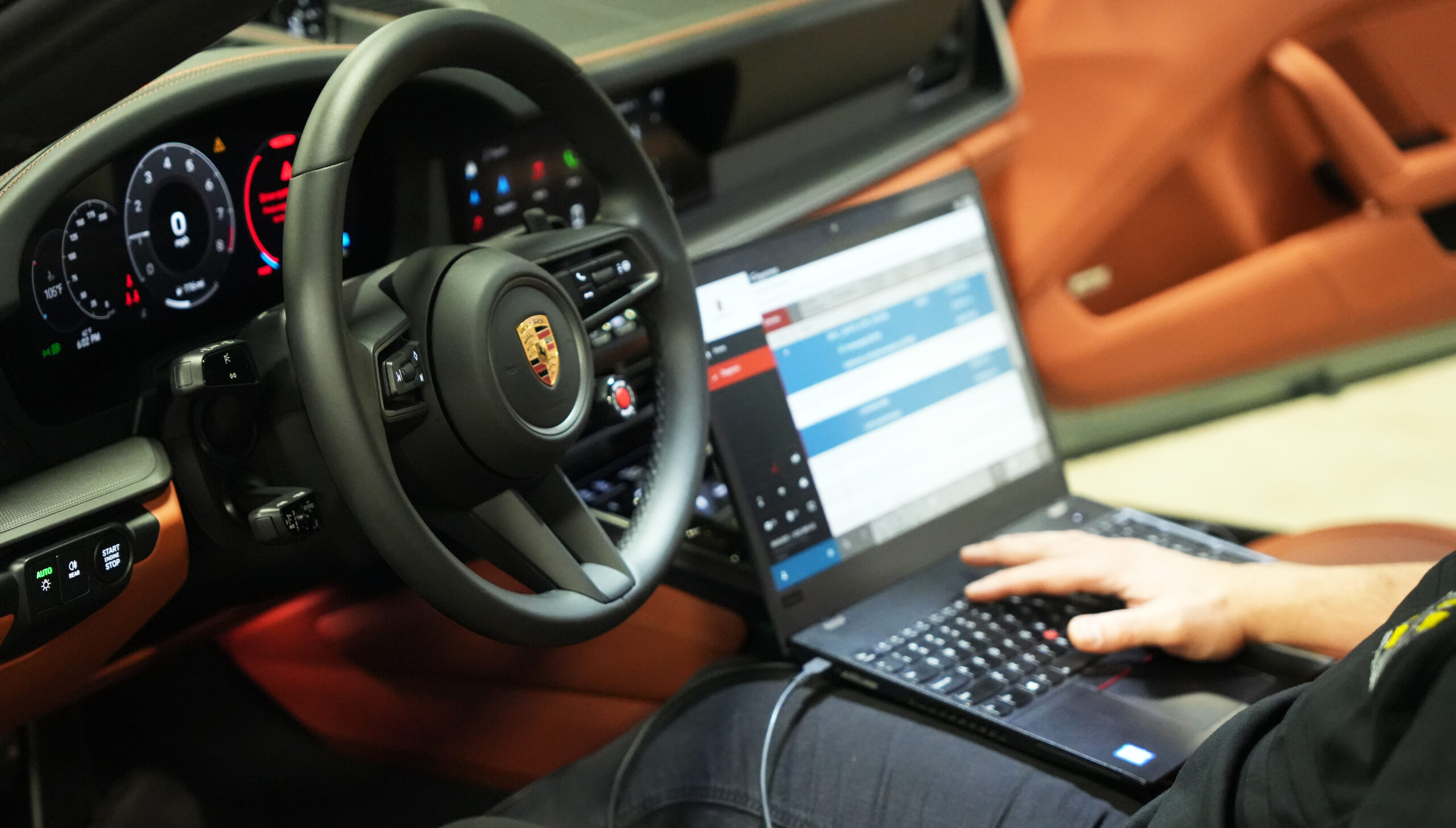
This is the practical question for anyone who does not live near a specialist, and the answer depends on the ECU. Older controllers such as the MED17 on the EA888 Gen 1 and Gen 2 and the Simos 8 on the supercharged 3.0 TFSI flash over the OBD port in 15 to 30 minutes. That can be done remotely with a laptop, a stable internet connection and a quality interface at your end. Newer Bosch MG1 and MD1 controllers and the later Simos 18 variants, which between them cover most Audis from roughly 2017 onward, left the factory locked. They refuse unsigned software over OBD. These need a one-time bench unlock: the ECU comes out, is connected through its bench connector or opened, and is patched to accept OBD flashing from then on. That step is physical. It happens in person or by shipping the ECU to us. After the unlock, every future flash, including a return to stock, a 95 RON file or a TCU update, can be done remotely.
The tooling behind this is the same we use every day for ECU programming and coding services. The ECU is read in full, the original file is archived with its checksum, the performance file is written, checksums are corrected, and the car is checked for fault codes and adaptation resets before it goes back to you. A tune is programming with a different file. The discipline is identical.
Why a VAG-Specific Tuner Matters
Generic remap tools can open an Audi file and move a boost table. They cannot see the gear-based torque limiters, the component protection models, the TCU handshake or the torque monitoring function that drops the car into limp mode when actual and modeled torque disagree. Many of the Audis we see for a second opinion arrive with a file that does the obvious things and misses the VAG-specific ones. The symptoms are familiar: torque cut on third gear pulls, a P0299 underboost code after a hard run, or a DSG that shifts worse than it did stock. Fixing that means reading what is already there, restoring a correct base and writing the file properly. Audi ECU tune performance comes from the whole calibration working together, not from the headline boost number.
What to Do Next
Stage 1 is the best value modification an Audi owner can make. Expect 20 to 30 percent more power on a turbo petrol, more on the V8s, with no hardware. Pair it with a TCU file on any S tronic or DSG car. Decide where you stand on warranty before, not after. Buy the intercooler before the downpipe if you drive hard. Log the car and send the logs in. And choose the person writing the file for their depth on VAG platforms, because that is where audi ecu tune performance is won or lost.
If you are not local, that is not a barrier. Our remote VAG programming service handles the flash, the TCU file and the follow-up log review from wherever you park the car. If your ECU is one of the locked ones, we will tell you so up front and arrange the bench unlock before anything else is promised.
Is Your VAG Vehicle Showing This Issue?
Whether you are a car owner dealing with a fault, a workshop needing a specialist partner, or an enthusiast looking to unlock your vehicle’s full potential, VAG Programming offers expert remote and in-person ECU coding, programming, and diagnostics for Audi, Volkswagen, Porsche, Bentley, and Lamborghini worldwide.
Contact us today and let’s fix it the right way.