
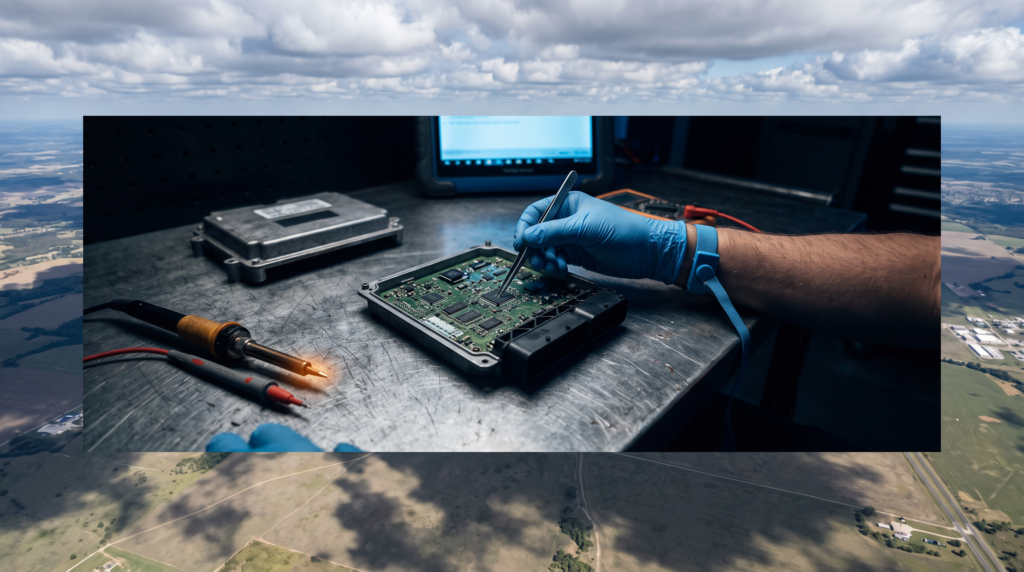
When an Audi throws a warning that points at a dead control module, the fix is rarely as simple as bolting in a new box. A current Audi runs dozens of networked ECUs that each have to carry the correct firmware and be matched to that specific car before anything responds. That matching is what audi ecu programming covers, and skipping it is the reason so many replacement units sit silent on the CAN bus with the engine still refusing to crank. Whether you own the car or run the shop, this article walks through what the job involves, when it is needed, what the process looks like, and what tends to break when it is done blind.
What Audi ECU Programming Actually Means
The phrase covers two connected jobs that people often blur together. Flashing writes the firmware image onto the module. Coding and adaptation then tell that firmware which engine, gearbox, sensors, and options the car actually has. On VAG vehicles both steps run over the OBD-II port, using CAN on pins 6 and 14, driven by the factory application ODIS or a capable aftermarket tool. Get the flash right but the coding wrong and the module wakes up talking to the wrong hardware.
Audi ECU programming is never a single generic procedure. A Bosch MED17 petrol engine controller, an EDC17 common-rail diesel unit, a DQ381 gearbox mechatronic, and a body control module each expect their own file set, their own security access, and their own sequence. The platform matters too. A B8 A4 on the older PQ architecture behaves differently from an MQB or MLBevo car, and the newer MEB electric platform changes the rules again. This is why a shop that flashes one engine family fine can still brick the next.
When You Need Audi ECU Programming
Most cars reach us for one of three reasons, and each one shapes how the job runs.
A failed or dead module
Water in a footwell, a bad ground during a jump start, or simple age can kill an ECU outright. A brand new unit from Audi arrives blank, or virgin, and has to be flashed to the car’s build spec and then coded. Ordering the part is the easy half. Without correct audi ecu programming the new module has no idea what car it is in. On some cars the replacement also has to be online-coded before the immobilizer will release, so the engine stays locked until the last step is done.
A used or donor ECU
Buying a used ECU from a breaker is cheaper, but it arrives married to another VIN. Audi and the wider VAG group lock most control units to the car with component protection, known internally as Komponentenschutz. Until that lock is cleared the module logs a fault and disables the function. Clearing it correctly is a specialist task, and our component protection removal service handles exactly this so a donor unit behaves as if it were born in the car.
A software update or fault fix
Sometimes the hardware is fine and the fix is a corrected software version, an updated calibration, or an adaptation reset. Our full ECU programming and coding services cover replacement units, used modules, and clean software updates on the same bench.
Inside the Programming Process
A clean job follows a disciplined order. First we read the car, not just the failed module. A full diagnostic scan across every control unit tells us the build, the existing coding, and any faults that will interfere. Tools like Ross-Tech VCDS make this reliable and repeatable, and you can read the same fault memory the factory tester sees at ross-tech.com.
Next comes the flash itself. For a module that still talks on the bus, the firmware writes over OBD in place. For a locked or dead controller, the file often has to go on the bench in boot mode, reading and writing the flash and EEPROM directly. After flashing, the car needs online Software Version Management, or SVM, which validates the new software against Audi’s central database through a secured GeKo account. That online step is what makes the repair official rather than a rough approximation. You can see how deep the electronics run across the current range at audi.com.
Finally the module is coded and its adaptations are set: injector correction codes, throttle body limits, steering angle, transmission clutch values on a DQ250 or DQ381, and immobilizer matching where needed. Only after that does the car drive as designed.
Getting the right file depends on getting the right information first. For any Audi ECU programming job we ask for the VIN, the part number stamped on the old module, and the exact symptom. The VIN pins the build to Audi’s records, the part number confirms the hardware and software level, and the symptom tells us whether we are chasing a dead unit, a coding fault, or a security lock. Guessing at any of the three is how the wrong file ends up on the bus.
The Risks of Getting Audi ECU Programming Wrong
This is where cheap shortcuts get expensive. A flash that drops out halfway, from a low battery or an unplugged cable, can leave the module half-written and unresponsive. Every VAG ECU carries a flash counter and a checksum, and a mismatch there flags tampering and can block future dealer work. Force the wrong file onto the wrong hardware revision and the unit is often scrap. Poor audi ecu programming also shows up later as limp mode, phantom faults, a warning light that will not clear, or an immobilizer that refuses to start the car.
There is a data risk too. On many controllers the immobilizer and security data live inside the ECU. Erase or overwrite them without a backup and you have turned a simple repair into a much larger recovery job. A steady power supply, a stable interface, and a verified original file are not optional extras. They are the difference between a running car and a paperweight.
Why a Specialist Handles Audi ECU Programming Remotely
The equipment and access that make this safe are neither cheap to own nor simple to maintain, which is why most general shops send the work out. A specialist keeps genuine factory software, a valid online account for SVM, verified original files, and the bench hardware to recover a locked ECU. That is a real barrier for a workshop that meets one virgin module a month.
The good news for owners and trade customers is that most of this no longer needs the car on our ramp. With a supported pass-through interface plugged into the OBD port and a laptop on the customer’s side, we run the session live over the internet. Our remote VAG programming service flashes, codes, and clears component protection without anyone driving anywhere. Bench-level recovery of a dead or locked unit still needs the module shipped in, and we are honest about which jobs fall into that group before you start.
Getting It Done Right
Replacing or repairing an Audi control unit is a software job as much as a hardware one. Correct audi ecu programming turns a blank or borrowed module into a matched part of the car, clears the component protection that VAG builds in, and leaves a clean fault memory with no hidden flags waiting to surface at the next service. Done wrong it costs a second module and a recovery bill on top. If you are staring at a dead ECU or a used unit that will not wake up, get a specialist on it before the guesswork starts, and keep the car where it belongs, on the road.
Is Your VAG Vehicle Showing This Issue?
Whether you are a car owner dealing with a fault, a workshop needing a specialist partner, or an enthusiast looking to unlock your vehicle’s full potential, VAG Programming offers expert remote and in-person ECU coding, programming, and diagnostics for Audi, Volkswagen, Porsche, Bentley, and Lamborghini worldwide.
Contact us today and let’s fix it the right way.