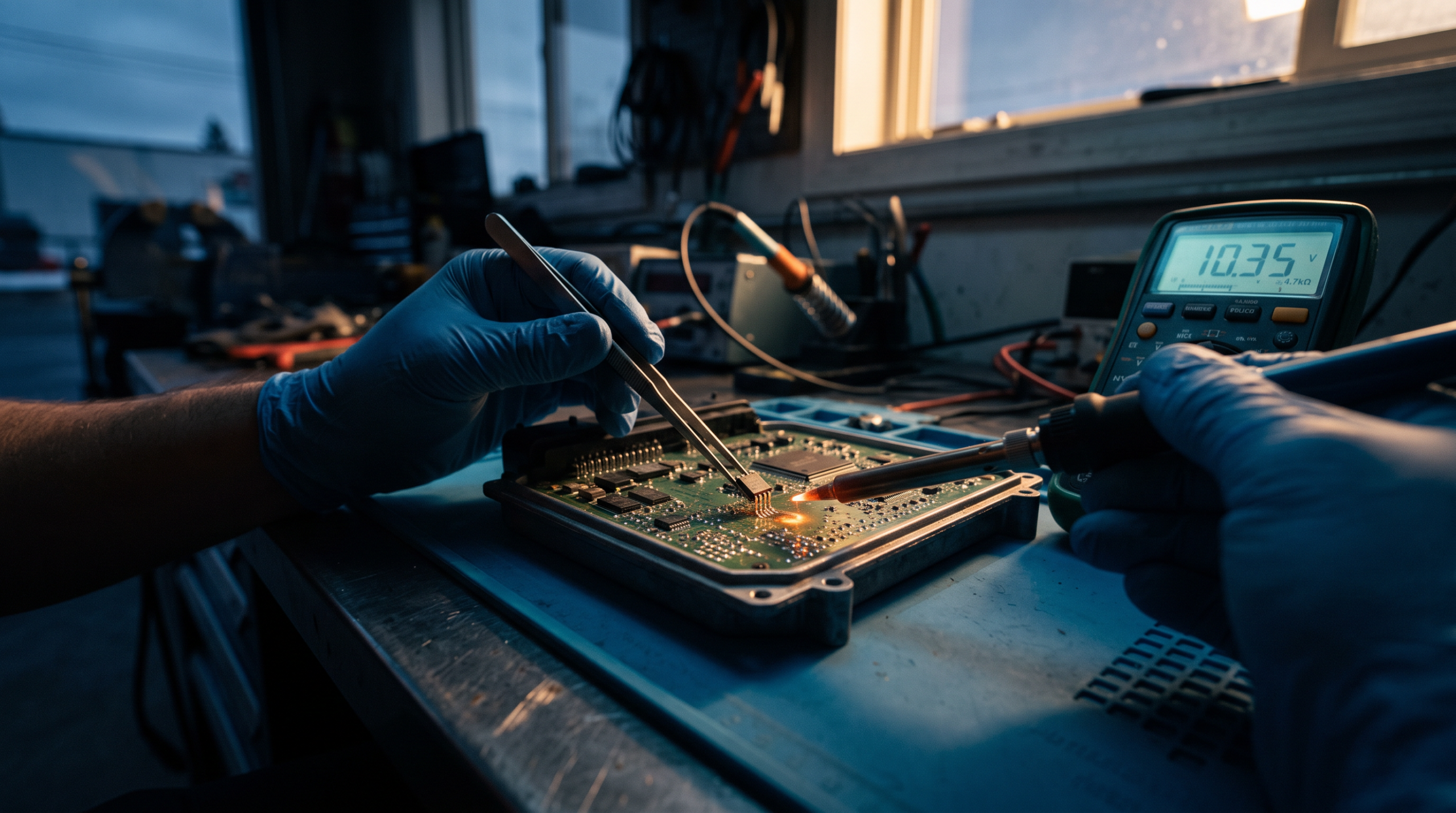
The honest answer to ecu replacement vs ecu cloning which is better comes down to one thing: what happens to the security data locked inside your original module. Replacement means fitting a different ECU and teaching the car to accept it. Cloning means copying the exact contents of your failed unit onto a matching donor, so the vehicle never notices a change. On older VAG platforms, cloning is the fast and clean route. On newer MQB and MLB-Evo cars running online component protection, the decision gets more involved, and choosing wrong buys you a no-start and a flatbed.
This guide is for owners and workshops facing a genuinely dead ECU, not a theoretical one. We will cover how cloning works at the EEPROM level, when a virgin or blank ECU beats a clone, and which platforms make cloning simple versus which ones fight back. For the full service breakdown, our ECU programming and coding services page shows what we handle on the bench and over OBD.
What ECU Replacement vs ECU Cloning Which Is Better Really Comes Down To
Both paths end with a running car, so ecu replacement vs ecu cloning which is better is really a question about work and risk, not about the part itself. A straight replacement uses a new or used ECU that carries its own identity. You then adapt it to the vehicle: write the immobilizer data, match the keys, and on modern cars clear component protection online. Cloning skips most of that. You take a donor ECU with the same hardware and software number, then write your original EEPROM and flash into it. The donor now believes it is your ECU, keys and all.
So the real pivot in ecu replacement vs ecu cloning which is better is whether you can still read the original. If the processor is alive enough to dump its EEPROM, cloning is usually the shorter road. If the board is physically destroyed, water damaged, or the memory is unreadable, cloning is off the table, and replacement plus a fresh adaptation becomes the only move.
How ECU Cloning Works: EEPROM Dump and Rebuild
Cloning is a copy job with strict matching rules. The donor unit has to share the same Bosch or Continental hardware number, for example a Bosch MED17.5 or a Simos PCR2.1, and ideally the same software version. Fit a mismatched box and the flash will not run correctly.
The method is simple in principle. Read the original ECU in full: the flash that holds the engine program, and the EEPROM that holds the immobilizer data, component security values, and adaptation bytes. Read the donor the same way. Write your original dumps into the donor, correct the checksums, then verify byte for byte. Because the immobilizer data travels with the EEPROM, the cloned unit stays matched to your existing keys, so there is no key programming and no immobilizer login. That is the whole appeal. This read step is the hinge of ecu replacement vs ecu cloning which is better, because a clean dump is what makes cloning possible at all. Our dedicated ECU cloning and data transfer service exists for exactly this scenario.
OBD reads versus bench reads
On older units a full read comes straight out of the OBD port, over the CAN bus on pins 6 and 14. On locked modern ECUs like the Bosch MG1 and MD1, the protected memory will not come out over OBD, so the unit goes to the bench. There we open it, power it directly, and read through the bootloader or BSL. Bench work is slower, and it is the reason some clones can be done remotely while others cannot.
When a Virgin or Blank ECU Beats a Clone
Cloning assumes you have a good original to copy. Sometimes you do not, and sometimes a clone is the wrong tool even when you do. A virgin ECU, meaning one with no immobilizer data written, is the better answer in a few clear cases.
- The original memory is corrupt or the board is dead, so there is nothing clean to clone.
- The car uses online component protection anyway, so the unit must be registered through the factory servers no matter what. A virgin unit adapts cleanly with the car’s own identity.
- You want a fully OEM-correct registration, with no leftover data from a donor’s previous life.
- The donor you sourced is itself locked to another VIN and cannot be neutralised any other way.
Virginizing takes the immobilizer and component security data back to a blank state. You then run a normal adaptation, and the ECU takes on your car’s identity. When you weigh ecu replacement vs ecu cloning which is better on an MQB car, this virgin route is often the cleaner long-term choice, even though it needs online access that a straight clone avoids.
ECU Replacement vs ECU Cloning Which Is Better by Platform
Platform decides more than anything else, so this is where ecu replacement vs ecu cloning which is better actually gets answered. VAG chassis fall into two rough camps: older cars where the immobilizer is local, and newer cars where security lives partly on the factory servers.
On the older PQ platforms, think Mk5 and Mk6 Golf, 8P A3, and B6 to B7 Passat with EDC16, EDC17, ME7, or MED9.1, cloning is straightforward. The EEPROM reads out easily, the immobilizer is IMMO3 or IMMO4, and a matched donor drops in with no online step. Replacement is also simple here, because a used ECU can be immobilizer-adapted with the correct component security bytes.
On MQB cars from roughly 2013 onward, the Golf Mk7, 8V A3, and third generation Octavia among them, and on MLB-Evo models like the Audi A6, A7, and Q7 and the related Porsche Cayenne and Panamera, online component protection changes the math. A used donor ECU will log a component protection fault until it is registered to the car through the factory GeKo and SVM system. This is where a clone earns its keep, because the cloned module keeps your original identity and never trips the protection. Where a clone is not possible, the fix is online registration or removal, which our component protection removal service handles directly.
Immobilizer and Component Protection Are the Deciding Factor
Owners fixate on the tune and the horsepower. In practice the immobilizer and component protection decide the whole job. The immobilizer stops the engine starting unless the ECU, cluster, and key all agree. Component protection, or Komponentenschutz, goes further, and refuses to let a control unit function until the factory confirms it belongs to that VIN. This is the layer where ecu replacement vs ecu cloning which is better stops being about the engine and starts being about security.
Cloning wins on the immobilizer, because the data copies across and the keys still match, so there is no key or PIN work at all. Replacement means rebuilding that relationship, which pulls key programming and immobilizer adaptation into the job. You can confirm an active component protection fault yourself in VCDS, and the Ross-Tech documentation explains what those measuring value channels actually mean before you commit to a plan.
ECU Replacement vs ECU Cloning Which Is Better for Your Car
Here is the short version. If your original ECU can still be read and the donor matches, cloning is usually the better answer, because the immobilizer stays intact, the keys keep working, and on protected platforms you sidestep the online registration entirely. If the original is dead, or you want a clean factory-correct adaptation on an MQB or MLB-Evo car, replacement with a virgin unit and proper online coding is the stronger long-term choice. That is the practical core of ecu replacement vs ecu cloning which is better, and it changes car by car.
What you should not do is guess. A mismatched donor, a half-read EEPROM, or an ignored component protection fault turns a two-hour job into a recovery job. Send us the ECU part number and the VIN, and we will tell you plainly whether cloning or replacement fits, and whether it can run over OBD or has to come to the bench. Many of these jobs finish without the car leaving the workshop through our remote VAG programming service, and we will always say honestly when the bench is the only safe way.
Is Your VAG Vehicle Showing This Issue?
Whether you are a car owner dealing with a fault, a workshop needing a specialist partner, or an enthusiast looking to unlock your vehicle’s full potential, VAG Programming offers expert remote and in-person ECU coding, programming, and diagnostics for Audi, Volkswagen, Porsche, Bentley, and Lamborghini worldwide.
Contact us today and let’s fix it the right way.