
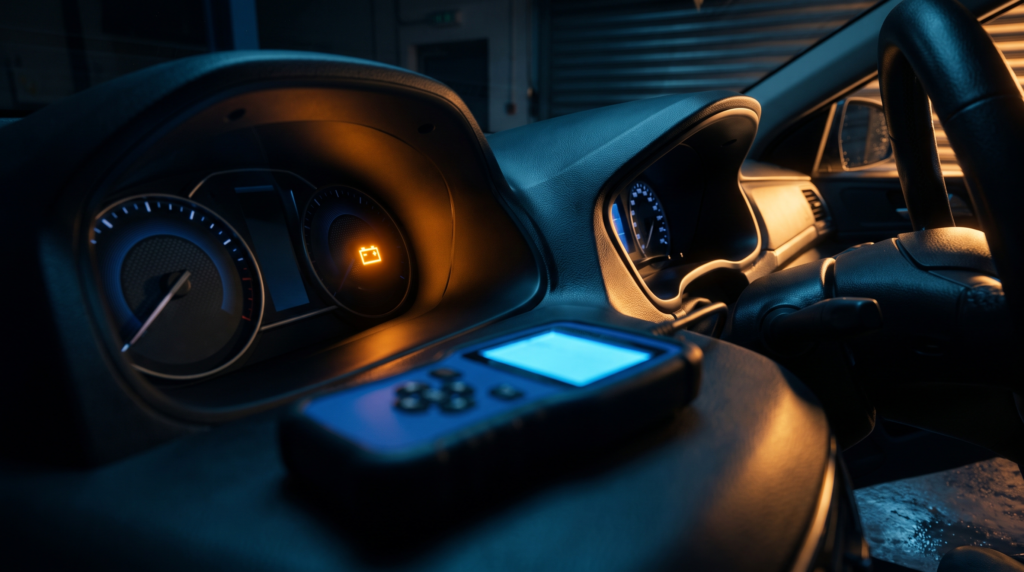
If your Audi or VW just stored the 18010 P1602 power supply ECU audi vw fault, here is the short version: the engine control module saw its constant battery feed, called Terminal 30, drop below the voltage it needs to stay awake. Most of the time this happens right after someone disconnects the battery, jump starts the car, or fits a new battery. In that situation the code is a harmless ghost. You read it, clear it, and it never returns. The rest of the time it points to a genuine fault in the power supply circuit that keeps logging until you find the weak link.
Let me walk you through what 18010 and P1602 mean, why they show up right across the VAG range, what you feel from the driver’s seat, and how a tech chases the cause instead of guessing.
What Does 18010 P1602 Power Supply ECU Audi VW Mean?
18010 is the VCDS number. P1602 is the generic OBD equivalent. Both describe the same condition: ‘Power Supply (B+) Terminal 30: Voltage too Low.’ Terminal 30, or Klemme 30 in the German terminal system VAG uses, is the permanent positive wire that runs straight from the battery to the ECU. It never switches off. It keeps the ECU memory alive so the module holds its fuel trims, throttle adaptation, readiness monitors, and fault log even with the key out of the ignition.
When the ECU sees Terminal 30 voltage fall under roughly 7 to 9 volts, or vanish completely, it records the 18010 P1602 power supply ECU audi vw code. It is not reporting a broken engine. It is reporting that its own brain lost stable power. On a healthy car that never happens on its own, so the code is really a flag that either the battery was pulled or the feed is weak. Ross-Tech documents this behaviour in their VCDS reference at ross-tech.com, and it matches what we see on the bench every week.
It helps to know the neighbouring terminals. Terminal 15 is the switched positive that only goes live with the ignition on. Terminal 31 is the ground return. Terminal 30 is the always-on battery feed. The 18010 P1602 power supply ECU audi vw fault is specific to that always-on Terminal 30 line, which is why it so often ties back to the battery itself or the heavy wiring between the battery and the module.
What Causes the 18010 P1602 Power Supply ECU Audi VW Fault?
The single most common cause is a battery that was disconnected. Anything that interrupts Terminal 30, even for a second, sets the 18010 P1602 power supply ECU audi vw code. Beyond that, here is what we check, in order:
- Battery disconnection or replacement: the number one trigger. Pull the negative clamp for any job and the ECU logs it.
- Weak or failing battery: a battery that rests below 12.6 volts or sags hard under cranking load.
- Corroded or loose battery terminals: green crust or a finger-loose clamp adds resistance and pulls voltage down.
- Bad grounds: the battery-to-chassis and engine-to-body straps corrode and raise circuit resistance.
- Water in the ECU box: on many Audi and VW models the ECU sits in the plenum chamber under the windscreen cowl, and blocked drains let water pool and corrode the connector pins.
- Failing alternator: if charging voltage sags under electrical load, the whole system runs low and the ECU notices.
- Blown or corroded fuse or relay: the main power supply fuse or the ECU relay feeding Terminal 30.
This fault is not tied to one chassis. We see the 18010 P1602 power supply ECU audi vw code on MQB cars like the Golf 7 and A3 8V, on MLB platforms like the Q5 and A4 B9, and on older PQ35 and PQ25 models. The circuit idea is the same across all of them, so the diagnosis follows the same logic.
Symptoms of a Terminal 30 Voltage Problem
Here is the honest part. Most of the time you notice nothing at all. If the code stored after battery work, the car drives normally and the only sign is a light on the dash or a code sitting quietly in memory. When the 18010 P1602 power supply ECU audi vw fault is live and current, though, the symptoms get real:
- Intermittent stalling or a straight no-start
- Rough idle for a few minutes as the ECU relearns its adaptations
- EPC light, check engine light, or a cluster lit up with warnings
- Other control modules logging communication faults because they browned out at the same moment
- Occasional limp mode until the voltage stabilises
If several unrelated modules all store faults with the same time stamp, that is a strong hint the whole car lost voltage together, which points right back at the power supply rather than any single component.
How to Fix 18010 P1602 Power Supply ECU Audi VW
Start simple. Read the fault with a proper VAG tool, note whether it is stored or current, then clear it. Drive the car, cycle the ignition a few times, and rescan. If the 18010 P1602 power supply ECU audi vw code stays gone, it was a leftover from battery work and you are finished.
If it comes back, treat it as a live electrical fault and test the circuit:
- Load test the battery and confirm resting voltage sits near 12.6 volts.
- Check charging voltage with the engine running. You want roughly 13.8 to 14.5 volts.
- Clean and torque the battery terminals and every main ground strap.
- Run a voltage drop test on the Terminal 30 feed from the battery to the ECU connector. More than a couple of tenths of a volt lost across that wire means resistance you need to hunt down.
- Pull the ECU connector and inspect for green corrosion or water, especially on plenum-mounted modules.
- Check the ECU power fuse and its relay.
This is electrical detective work, and it is exactly the kind of structured vehicle diagnostics and troubleshooting that separates a real fix from a parts-cannon guess. In the rare case the ECU itself has failed from a voltage spike or water damage and needs replacing or rebuilding, our ECU programming and coding services handle the coding and adaptation so the replacement unit talks to the rest of the car correctly.
Related VAG Fault Codes to Check
The 18010 P1602 power supply ECU audi vw fault rarely travels alone when it is genuinely live. Scan the whole car, not just the engine module, and watch for:
- P1603 / 18011: internal control module fault, often stored right alongside a supply problem.
- 00532, low supply voltage: the older VAG voltage-supply code seen on PQ platforms.
- U-codes for CAN communication: modules reporting lost contact after a brownout.
- P1543 and similar B+ codes: other voltage-supply flags depending on model year.
- Immobilizer or adaptation faults: the ECU can log these when it loses keep-alive memory.
Clearing every code and then rescanning after a road test tells you which faults the voltage drop caused and which are separate problems. You can cross-check any code you find against official manufacturer resources such as Audi service documentation.
When Remote Diagnosis Makes Sense
Plenty of 18010 P1602 power supply ECU audi vw cases are a five-minute clear-and-verify job you can do on your own driveway. Some are a corroded ground you find with a multimeter. But when the code hides behind an intermittent connector fault, or when clearing it needs proper VAG-level tooling you do not own, remote help gets you there faster. We connect to your car, read live data, clear codes, and guide the electrical checks through our remote VAG programming service, wherever you are in the world.
The takeaway on the 18010 P1602 power supply ECU audi vw fault is simple. Treat it as a voltage message, not an engine failure. Check the obvious battery and ground connections first, verify with a rescan, and only chase deeper wiring or ECU work once the basics are ruled out. Get the power supply solid and the code stays gone for good.
Is Your VAG Vehicle Showing This Issue?
Whether you are a car owner dealing with a fault, a workshop needing a specialist partner, or an enthusiast looking to unlock your vehicle’s full potential, VAG Programming offers expert remote and in-person ECU coding, programming, and diagnostics for Audi, Volkswagen, Porsche, Bentley, and Lamborghini worldwide.
Contact us today and let’s fix it the right way.